Wednesday, January 31, 2007

On Being Challenged

Ok, so yesterday I said I wanted to write a post responding to the posts to which I linked (and I'm not doing it again because I'm lazy), but somehow I couldn't organize my thoughts enough in order to write anything that made sense. To summarize what other people said, Aspazia began the conversation by talking about the ways in which younger female faculty are challenged - quite literally, by students and by colleagues - in ways that male faculty don't face, and while many women said the equivalent of, "Sing it to me, Sister!" others responded with, "Hey, I'm oppressed, too! What do you mean women have it rough?" or "While it is true that women have it rough, I too have it rough even though I look like I'm part of a group that doesn't." (For a great recap of the discussion, check out this post over at Blogher.)

Now, I feel like I've posted about this issue before - maybe on this blog or maybe on my previous blog - I don't know. But there ARE very real ways in which younger female faculty are "challenged" beyond their male counterparts. While it's true that all faculty members face challenges, students are, in my experience, much more likely to back down in the face of a male prof's authority. Or, conversely, students are much less likely to dismiss a male prof's authority if the male prof exhibits some flexibility or is, I don't know, nice or kind to students. I think that this is fairly standard stuff. But the reason that I want to write about it again (because how could I not have written about this even though a quick search makes it seem like I haven't?) is because I hate the way that discussions like this often end up being about measuring pain or oppression or victimization by the cold, hard world that is the academy or whatever.

This is not to say that this profession doesn't have many victims. Not at all. But I hate it when a discussion about equity in one specific area is perverted into a discussion about the ways in which people from other identity categories have it bad, too, which then serves to invalidate or to obscure the original discussion. This happens all the time in discussions in my discipline specifically because of the horrible job market. Everybody has a tale of woe, and so it's very difficult to separate out anything from that. It's very easy to dismiss this kind of discussion because there's always a counter: "But what about adjuncts? They have it worse than you, oh woman on the tenure-track. Or what about women of color? How can you, white girl who's had it so easy, claim to have problems? Or what about people who are younger/older, gay, who have to care for children or elderly parents or who are married and can't live with their significant others- " blah blah fucking blah.

I'm not trying to dismiss the experiences of those groups (in spite of the blah blah fucking blah above) but at the same time, when the discussion takes this turn, it basically stops all discussions cold. So I think there's value in limiting the discussion, if only because I'm much more interested in trying to come up with strategies for change rather than in measuring pain or difficulty or whatever it is we're measuring when we start comparing one group's (or person's) experience to another's.

Ok, so now that I've gotten that off my chest, what do I think about the issue at hand - the unique challenges that women faculty face when they're on the tenure track?

First, I'd say that while the challenges themselves are not necessarily unique (difficult students, challenges to authority, issues with evaluations, being sucked into more service than perhaps is appropriate), the ways in which women must face these challenges and attempt to handle them are. And if we're going to have this conversation, we've also (I think) got to discuss the way that discipline and/or subspecialty within a discipline factors into these issues.

As I see it, the circumstances that affect me (and I'm only going to talk about me here, as I know most about my experiences in this context) in dealing with life on the tenure-track are as follows:

English, as a discipline, is perceived as being sort of warm and fuzzy, and students often think that there is no "objective" measure of merit.
This comes into play particularly in classes that are for non-majors, whether we're talking about writing classes or classes or literature classes that fill general education requirements, the "service" classes of my discipline. Whereas students who enter a math or science class accept that there are "right" answers, students who enter an English class often think that their "experience" of a text or their "interpretation" of an assignment trumps everything else. Thus, if a faculty member (male or female) doesn't set up clear expectations, he or she will be in for trouble. That said, what counts as "clarity" is gendered in our culture. Students will often expect a female faculty member to provide step-by-step instructions in a way that they do not expect male faculty members to do. If one compares syllabi or assignments between male and female faculty members, one can often see this difference manifested. I have male colleagues whose syllabi are incredibly brief, whose assignments consist of a prompt and little else. Students do not give them low evaluations for clarity nor do they give them low evaluations for preparation of material. Moreover, students seem to accept that if they need further clarification that it is their responsibility to seek it from the male faculty member. In contrast, students may receive mountains of paper explaining things from female faculty members, but nevertheless, they will complain that the expectations were not "clear." One might argue that the mountains of paper in fact obscure clarity. But if the female faculty member does not provide those, then she has no recourse when the student does not meet the expectation and then challenges her policies. It's a catch-22.

Moreover, in these classes a lot of what we're teaching is that one's opinion, if it is not rooted in the text, does not have authority. This goes against what students seem to learn throughout their K-12 education and what students see in popular culture about how to evaluate texts (think Oprah's book club). And so students will often enter, say, my intro to lit course with the attitude that all opinions about a literary text count equally, and that they are as equipped to judge a text's merit as somebody, say, with a PhD. They enter my male colleague's classes with the same attitude. That said, some students think that because I'm a woman I do not have the authority to challenge them in the classroom. They perceive any challenges that I do make to their claims as without authority and as without foundation because of expectations that they have about me based on gender. For this reason, I've learned to consider gender as I approach challenging my students about their ideas, to conform to certain kinds of gender expectations even as I challenge them.

Area of specialization does make a difference.
I do notice a distinct difference between how students in general education type classes respond to me and in how my upper-level students respond to me, and I don't think that this is purely based on the fact that the students are more mature. I think that subject matter plays a key role in my ability to exude and to exert authority in my classes. The upper level courses that I teach are in my field of specialization, which is a somewhat "masculine" (read: difficult) field. It is very difficult to reduce one's readings of these texts to "identifying" with one character or another or to any sort of personal satisfaction that one might feel at the end of a reading assignment. (In fact, there is often no sense of satisfaction provided by the narratives of things that I teach, which students often find frustrating.) Because the texts tend to be so seemingly impenetrable, students characterize me as "the subject who knows" in my upper level courses, and they are much more willing to accept my authority in other areas because of that. In contrast, in most of my lower-level classes (with one exception), in which I often teach more accessible texts, students are much less likely to grant me the same kind of authority.

Department and local culture is also a factor.

While it is true that English is a feminized discipline and that there are generally more female than male professors in most departments, all of my department leadership (and most of the tenured professors, and I think, if I'm not mistaken, all of the full professors in the department) are male. This sends a message to students that women are kind of subordinate professors, helper professors, who don't really count. Moreover, this area is very conservative, so most students (male and female) themselves embody very traditional gender roles and have very traditional expectations for how women and men should behave and what kinds of roles that women and men should play. This means that they respond to me in certain ways that I don't think students in other localities or at other universities would.

So how have I dealt with all of this?
Well, part of how I've dealt with it, which may seem counterintuitive, is to relax a little bit about the authority stuff. I run my class the way I run it - take it or leave it - and I don't worry so much anymore about keeping up an authoritative front. If students are going to respond to me as a woman first - let them - I just need to make sure that they realize that it won't make one bit of difference in terms of how well or poorly they do in my courses. The second thing is that I nip all challenges to my classroom administration in the bud. Immediately. In class. If a student shows up late, I call them out on it right then - I don't keep them after class and gently mention it to them so as to keep their pride intact. If students are talking while I'm presenting material, I stop, and I stare at them until they shut up. After the first two weeks, these things stop happening. I also am very vocal about issues I face in my classroom with my higher-ups, which I think helps in that I get their support from the get-go and if things come up later, they are less likely to affect how my higher-ups perceive me.

There are other things, but this post is going on too long and I need to stop blogging and start my day. I suppose the ultimate point, however, is that dealing with this crap is an ongoing process. I think (or hope) that things will improve once I get tenure, once I look a little older, or once I get a wedding ring on my finger (for with that ring - and with children - does come a certain kind of authority that I do not have, at least at this institution). The thing for me, though, is not to get bogged down in thinking about these issues, because doing so drives one crazy. And that has gotten easier, especially as I've taught so much in the past three years that I've got prep down to a science and running a class is like riding a bike. (In some ways I think that this is the biggest benefit of the 4/4 - much less time to agonize about abstract things like "authority" or to worry about preparation or overpreparation.)

So I hope this post contributes positively to the ongoing discussion. Though I really do apologize for how long the thing is - I didn't think I had so much to say!

Tuesday, January 30, 2007

And THIS Is Why I Don't Like to Order Pizza

Ok, so I've got this thing. I hate calling up to order a pizza. The whole process just freaks me out, and it always has. (A companion phobia is I hate calling to make reservations at restaurants.) I will most often just get pizza at the grocery store rather than order pizza because I hate calling to order a pizza so much. And I've been doing the healthy eating thing for a while now, so I've not even done that recently. But today was a long, hard day, and I really wanted a goddamned pizza from a pizza place (also because it's like -40 degrees with the wind chill and I can't imagine leaving my house) and so I overcame my pizza-phoning phobia, and I called them up.

All I can say is, this was not a simple transaction. I called Pizza Place #1. I swear to god I had some sort of illiterate person on the phone. All I wanted to order was one sausage and pepperoni pizza. This should have taken just five minutes, right? Right? Oh no. The kid couldn't spell (not only my name, but the name of the TOWN I LIVE IN), he kept reversing the letters/numbers in my address and phone number, and I was on the phone with him for TEN MINUTES before I finally gave up and told him just to forget it. (I was on the phone that long because I thought that I would be nice to the poor guy, and I felt like I should support his effort to have a job since clearly he couldn't read, and he seemed incredibly stressed out and I felt bad for him.)

So then I called Pizza Place #2. That went much better. But I'm saying, why, WHY, WHY does calling for a pizza have to be such an ordeal? And why don't I have a boyfriend who will call and order pizzas for me, because really, that is one of the primary roles that a boyfriend would have in my life. (This is also one reason why I tend to weigh more when I am in a relationship, so perhaps what I really need is a guy who refuses to order pizzas for me.)

Anyway. In 50 minutes I'll have pizza. I almost don't want it anymore, but after all of that effort, I have to eat the pizza on principle.

Edited to Add:
Pizza Place #1 tried to deliver me a pizza anyway. And the delivery guy got lost on the way to me. When he got to the door, I realized that he was the wrong Pizza guy, so I sent him away. He crossed paths with Pizza guy from Pizza Place #2, who proceeded to tell me how Pizza Place #2 is filled with drug dealers and they're not a good Pizza Place. Dude, I'm not ordering pizza again for a year.

The Challenge of Being a Female Academic

There are a lot of posts around discussing the "unique" (or not-so-unique, according to some) challenges that women face in academic careers. (Anastasia also has a great tangent post that is worth checking out that doesn't really address the gender issue.)

***

I really want to jump into the fray and write my own post about challenges, but after two false starts, I think that I'm going to admit to myself that it's early in the morning and I can't really manage that sort of a post. At least not right now. Suffice it to say that I've got my opinions, and if I can organize them in any sort of comprehensible way I'll post about them later.

Monday, January 29, 2007

Ok, Loving the Labels

It's really easy to add them. Who knew? Though I'm not going to get anywhere near adding them for the whole archive right now. But yes, I am hopeful that I will manage to label everything very quickly, ultimately.

The question is, will I be able to figure out how to list my labels in my sidebar?

But for now, I must away to my bed, where I should read something other than Harry Potter, but where I will read Harry Potter.

Ooh! Love labels! That said, am not sticking a label on this dumb post, as it's barely worth a label.

'night, everybody!

Crossing over to the Dark Side

So I've finally switched to the new and improved blogger. I'm excited about labels, but we'll see how I feel about the rest of it. The question is, will I really go back through and label all the old posts? Hmmmm.... Seems like a good procrastination thing to do....

In other news, I went and saw Notes on a Scandal tonight. It was excellent - and really did do justice to the book. Obviously it was not identical to the book (otherwise would not have been excellent) but was very well done. I've got to say, I think it was a much better movie than The Queen, though I think too creepy for anybody to vote for it for an award. And hey - does Judi Dench really NEED another award? Not really. But yes, so this is a movie that you should all go see. For real.

Sunday, January 28, 2007

One Thing I'm Not Modest About

I am one hell of a good cook.

Of course, you only have my opinion to go on, and I suppose the corroborating opinion of my mom ("You'll really make somebody a good wife someday!" - gah!), because it's rare that I cook for other people. Weird fact about Dr. Crazy: I really enjoy cooking for myself most of all, and I really hate entertaining. For this reason, few people have ever actually tasted my cooking, unless they are in my "inner circle." Oh, I did make a lasagna that got raves for a department potluck, but yeah, I really don't cook for anybody but myself. Maybe this makes me a selfish cook.

Anyway, this weekend I made a delicious potato soup with leeks (recipe from the best cookbook ever, How to Cook Everything - though really to make it creamy all you need to do is take a potato masher to the potatoes - you don't need an immersion blender, and some chunks of potato are quite nice - and you don't really need to add cream if you're trying to be figure-conscious - and for breakfast today I made delicious french toast, and for dinner tonight, I made a fabulous putanesca sauce (although it was even easier than the recipe I posted, as I had some tapenade I made previously in the fridge, so I just used some of that in place of the olives, capers, and anchovies, as tapenade is olives, capers, and anchovies), pasta, and a modified version of chicken parmigiana, of my own invention, with homemade breadcrumbs and boneless/skinless chicken breasts. It was all. so. good.

(And does anybody else feel like milk is the absolute best beverage to drink with tomato-related foods? Because the glass of milk that I had with dinner really hit the spot. I love a glass of cold milk with dinner. It's just so good.)

In other news, today I accomplished the following:
  • Taxes. I know, I can hardly believe I was this on the ball about this either. But I really need the refund :)
  • Preparation for upcoming trip.
Things I did not accomplish:
  • Prep for classes.
  • Grading for classes.
  • Work related to book proposal/manuscript.
Maybe I'll accomplish some of the above before I sleep. Probably not.

Friday, January 26, 2007

Research at a Teaching Institution

Last night I did this post about research, and then this morning, when I woke up, I decided to take it down. I rarely do that - even when I probably should - just because I feel like, what the hell, that was what I wanted to write at the time and I've got to own whatever it is that I wrote, even if I feel like I don't like it now. But I chose to take that post down because I felt like it was weirdly apologetic and yet also disingenuously modest and yet also not really true. And also really long-winded and without a point.

But so throughout today I've been thinking that I wanted to do a post that actually does talk about research in a real way, and specifically about my experience as a person who does research at the kind of institution at which I teach.

First, I should say that since I realized I enjoyed teaching and that I had a talent for it, teaching and research have never been in competition for me. For me, each contributes positively to the other, and that's not just a schtick I've worked up for cover letters and performance review purposes. I really do believe that I'm stronger as a researcher when I'm devoted to my teaching and that I'm stronger as a teacher when I'm devoted to my research. That's just the way I roll.

I know that not everyone has that experience - some feel like teaching takes them away from their research and still others resent the demands that research makes upon them that stop them from focusing on what they do in the classroom. I don't fall into either of those camps, not really. Sure, I resent having to teach writing as much as I have to teach writing. Part of that is because I don't really believe it's where I'm strongest as a teacher, and I get frustrated when I feel like I'm spinning my wheels, spending great amounts of time on something that I'm not really very good at and not likely to get better at doing. I often feel in the writing classroom that I've got to lower my expectations for what I can achieve with my students, whether for my own sanity or whether to accommodate the students themselves, and I really hate feeling that. But this has a lot to do with the unique configuration of writing requirements at my institution. I'm not sure that I would feel the same about this part of my job in another context, and how I feel about this part of my job does not extend to a feeling about teaching generally.

But I didn't get into this gig to be "just" a teacher. If I had wanted to be "just" a teacher, I would have gotten secondary certification and taught high school. The attraction for me to being a professor - not "just" a teacher - was really deeply connected to my love of research. Now, I'm not the best researcher in the world. I'm not setting the world on fire, and I really don't think I'm that wildly productive. I pursue questions that are interesting to me, and I do so in a methodical way, and then things happen because of that. I don't say no to opportunities that cross my path. But I don't devote time each day (or even each week) to research, and I don't spend my summers writing like a maniac. If I've got a particular project, with a deadline, I do the research stuff. I devise projects because I'm interested in thinking about certain things - if I didn't have an idea that I wanted to pursue, I probably wouldn't have projects just to have them or because I felt obligated to do so, particularly in my current job. It's just not necessary to do that here.

But since it's not necessary to do research (beyond one article and attending some conferences) at my institution, that leads to some questions. One question that many people ask me (astonished) is how I've managed to be active in my research given the things that ARE required at my job (MUCH service, MUCH teaching). Another question is why I do it, given the fact that the deck is in some ways stacked against me.

But so first. How have I "managed"? I think part of it comes down to personality. I think I'm actually more likely to do research when I've got to squeeze it into limited blocks of time. I feel less pressured about it (which may seem contradictory, but for me that's because I don't feel like I've got to do something "good" but rather that I've just got to get the task completed, which is kind of liberating) and I don't get bogged down in minutiae as much. I also think I've been very good at being efficient with the projects that I take on, so that I'm not doing three radically different projects at once that are also radically different from anything I teach but rather that all of my various projects are intertwined, so reading one article "counts" for like 4 different things. Finally, I've managed because I've made it a priority to do so. I care about research, and I feel like I'm losing something if I don't do it. Some people feel that as well, but because they are so overwhelmed they just come to resent their job or to give up on trying. My response is rather to make sure that I find a way to keep this part of my intellectual and professorial life alive, whatever else I'm doing.

So yes, maybe I'm uniquely suited to being doing research while working at an institution at which research isn't terribly important. And maybe I've developed habits that contribute to my success with keeping active in research. BUT - and this is a big but - it's not all down to me. Most of the time, things end up falling into my lap. I don't have some big agenda that I devise strategically about what I will produce in a given year, and really the only research goal I've ever had is to get my damned manuscript into shape and get it published as a book. Otherwise? I'm pretty relaxed in my "plans" (if you can call them that). I think that's probably a good thing, as it means I don't beat myself up when something falls through or when something doesn't happen. Since it wasn't a goal, it's not a failure. Also, I've been lucky to have really great mentors who've sent projects my way, and I've been lucky to fall into working on something that seems to be becoming kind of "hot." (Well, not hot-hot, but not cooling off, if that makes sense.) And I got really good advice about how to market the work that I do, and so I have been steadily developing a higher profile in a very specific subspecialty.

As for why I continue, well, I really resent being told that the research I'm doing isn't important. I know that's not what my colleagues mean when they tell me that I can cut back, but that's the message that I get. I really believe in what I'm working on, even if it's not that important to most people. I really like the idea that something that I could write might make somebody read a text in a different way. And, hell, I just like to write. I enjoy it. But there is also this: I think that I need to do this kind of work in order to be content in the other kinds of work that my job requires. And no, I'm not at some fancy research institution, so I shouldn't have to do as much research as somebody there might (and I don't) and I don't actually aim to be at that kind of institution. What matters to me, though, is that people respect my intellectual life. When colleagues say to me that I should cut back on research, it feels like just another version of some members of my family deriding me for not getting a "practical" degree. Maybe what I'm doing isn't essential to anybody but me, but that doesn't mean that it isn't important.

So the battle, at an institution like mine, is a battle to keep one's intellectual life even when that's not what is most essential to the running of the institution. I imagine the opposite is true for people at research universities - that they must battle to keep teaching a priority. And it's not impossible, but it is challenging - and at least in my experience, the greatest challenge is not in carving out time to do that but rather in carving out the mental and emotional space to do it.

The likelihood is that more people teach in institutions like mine than in institutions like the one where I got my PhD. And getting a PhD at that kind of institution does not prepare you for the challenges of doing research at this kind of place. Sure, they warn you about needing to say no to things and about carving out time for your research, but they don't warn you that you'll also need to find a way to believe in how important your research is when those around you don't really care one way or another. They, I think, probably don't know to warn you about that because it's incomprehensible to them that other people with PhDs would have that kind of an attitude. So, my time on the tenure-track has been an education, in that regard. And if I stay here, I need to gear up for continuing to fight this fight, because I really do think that it's important. And if I go? Well, I'll cross that bridge when (or if) I come to it.

Thursday, January 25, 2007

"You know, if you're feeling overwhelmed..."

Ok, so recently I sent out a call for papers for a panel I'm organizing for next year's MLA. Ho hum, tra la, I'm excited about the panel but come on - I won't really need to think about it until like March 15 because seriously, nobody's going to utter a peep about it until the deadline hits or it passes, right?

But then this morning I got an email from an editor at a real actual academic press (and not one of those con-artisty ones that asks you to pay for the printing costs and such) who apparently saw the CFP and who wanted to know whether I'd thought about expanding it into an essay collection.

Ok, so I had thought about it in the way that you think about things that you don't let yourself think about. It occurred to me when I came up with the idea for the panel, but then I immediately pushed it from my mind because a) I'm on the job market b) I'm shopping the proposal for my monograph c) I'm teaching 3 classes, doing the quasi-admin position, and doing enough service to kill a mule. In other words, I've got enough on my plate without heaping an editing project on top of it.

But of course, when you get an email from a non-con-artist editor inviting you to submit a proposal for a collection, and when you're Dr. Crazy and you'll do almost anything when you feel flattered, well, the collection that you weren't even going to think about all of a sudden becomes a thing that you're obviously going to do.

You may be interested to note that I met with a senior colleague recently, and in that meeting he said, "You know, if you're feeling overwhelmed, you could cut back on research."

I so hope that I get another job offer. Because clearly I do not belong in my current job, given my interest in juggling multiple research projects and their interest in telling me that my research is the first thing that should go if I'm feeling overwhelmed.

(I should note that the things that make me feel overwhelmed tend to be teaching and service. Note that nobody tells me to cut back on either of those.)

Wednesday, January 24, 2007

More on Teaching, or, Yes, You Really Do Need to Come to Class

Hmmm. How to begin this post?

The semester is off and running (I'm already in my third week) and it's about that time where bigger assignments are coming due in my courses. Not big-big, but formal, graded assignments. And a few students have either missed class, come late to class, or zoned out during class, and this means that they've missed crucial announcements. And it's got me thinking because I'm wondering whether this is a weakness in my classroom administration or whether it's actually not my problem.

I suppose I should give some background. In all of my courses, I distribute a pretty explicit syllabus (course schedule and course policies). Each class meeting is listed on the schedule, and next to each date is the reading assignment for the day (title of text) as well as any out-of-class assignments that are due. As for the course policies, well, I make it clear that attendance is mandatory. I also make it clear that you've got to have the text for the day with you in class, and all of that other neato stuff that you're supposed to put in your course policies.

I don't, however, include page numbers (if we're covering a text over multiple class meetings) nor do I include what exactly we will do in class (because, well, it changes from year to year, semester to semester, class to class). I also don't have a really hard-core attendance policy where after a certain number of absences your total grade for the course goes down or where you automatically fail (though attendance does affect your participation grade). So it's pretty explicit, but not suffocatingly so. There is room for me to move within the explicit course schedule that I design. And I ALWAYS stay on schedule. Not since my first year on the t-t have I deviated either by removing texts or by changing dates on which assignments are due.

I should also say that I hand out all out-of-class assignments with ample time (usually one week, sometimes more (I hand out all assignments for upper-level classes on the first day), sometimes just less than a week if it's an "ungraded" assignment) for students to get going on them, I give out review sheets if we're to have a test or exam (also within 5-7 days), and I always spend at least a little class time before the first graded assignment in any course going over what they need to do and what my expectations are.

So far, so good, right? And remember, I do emphasize attendance and being on time, and so if students just show up on time and stay awake, students should know exactly what we're doing, right?

But the rub is that because I assume that students attend, and by attendance I mean being on time and being there not only physically but also being there mentally, not everything is written out and set in stone on the syllabus. I don't necessarily say on the syllabus when I will go over the first graded assignment; I don't necessarily say what exactly the reading assignment for the next class is until the class before. In my mind, this allows for flexibility. It means that if we don't get far enough in discussion one day on a text that is stretching over multiple class periods (for example) that I can assign a little less reading for the next class. Or, if we cover a lot in a day, we can go a little farther for the next class period. And while my assignments state the basic requirements for what they need to do, on, say, a paper, I do tend to give supplementary information about my expectations in class, if there is supplementary info to give. I don't state "I'll give out the pages to read for the next class" on the syllabus, nor do I necessarily say "I'll be talking about the test or paper or whatever on this date" on the syllabus. To me, this is what coming to class is about - getting this supplementary info. If you aren't in class, my theory is that you should just do all of the assigned reading (or guesstimate about what we'll be able to cover in a class period) or that you'll go it alone on the assignment, which you've already received. If you miss class before a test, you should assume everything we've covered to that point should be something that you study.

Moreover, if I've got handouts or assignments to give, related to course material, I don't necessarily keep them in my bag throughout the entire semester. Sometimes I clean out my bag, so I don't have everything I've ever handed out with me. It states clearly in my course policies that if you miss class you need to ask somebody else in the class what you missed - not me. If a student misses a handout or an assignment, I expect them to ask me for it when they've found out they missed it from a classmate. And if I don't have it with me, I tell them to email me, and I'll be happy to send it to them as an attachment. In some classes I even post assignments online so that they can just go to the website to retrieve them.

So. I've got these students. They've not attended class, or they've come late, or they've left early, or they fell asleep. To me, they're adults. If they miss stuff, they miss stuff. It's their responsibility to find out what they missed. But at the same time, if they're missing so much stuff, and then they don't turn things in when it says that they are due on the syllabus, why are they taking the class at all? What can they hope to get out of it, and what am I supposed to do to teach them if they're not there to teach?

My thought at this point is that it's not really my problem. I'm very clear - from the first day of class on - about what my expectations are and what their responsibilities and my responsibilities are. But I don't know. What if what I'm describing here is not flexibility but rather lack of organization on my part? My preference would be to maintain in the fashion that I've been going, in part because I hated as a student syllabi that constantly changed, that were so rigid that they could not be followed. And I do think there needs to be wiggle room - not only in syllabi, but also in assignments. So my question for you, readers, is whether you think I'm being unreasonable. And if you do, what would you suggest I do to become more reasonable?

Man-Kitty Having His Afternoon Bath

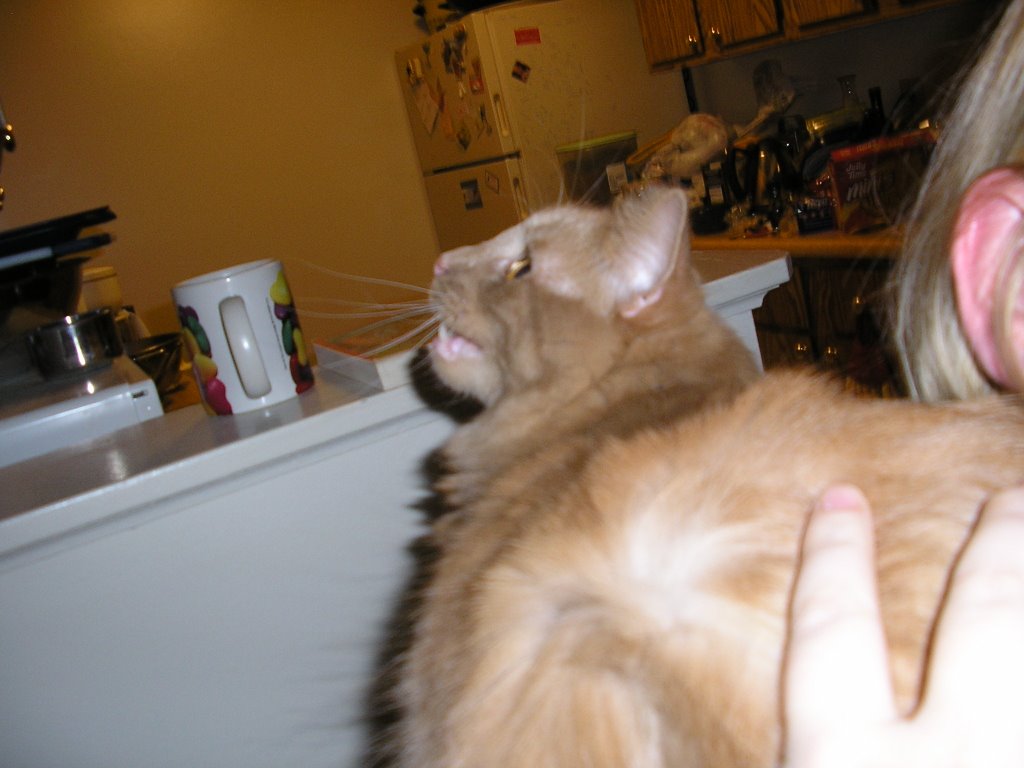
It's been a while since I've posted a picture of the Glorious Man-Kitty, and as I was on the telephone with Medusa just moments ago (and she may be adopting a doggie! and there's a picture of the doggie on her blog!) the Man-Kitty decided to be very cute indeed, and so I snapped this photograph.

I do believe that this is the first ever picture of his tongue, and he is cleaning his little toes, which I always find to be a very cute thing indeed. You will notice that he is also sitting near (on top of) a shoe-lace. This is his FAVORITE possession, and he will often bring it to me in his little mouth to indicate that he needs to play, or that he needs love, or that he just wants some conversation.

So for all of the Man-Kitty lovers out there, here you go!

I Really Am a Naturally Cheerful Person

You know, apparently all I needed was to write in my journal, whine to my mother, whine to my BFF from grad school, read some Harry Potter, play some Sudoku, and get a good night's sleep and I woke up feeling INFINITELY better this morning. That's not to say that the sources of frustration have disappeared, or that the stress of job-seeking while dealing with those frustrations is any less, but I'm much more philosophical about it all today. I'll just be happy when all of this crap I'm dealing with is over with and things reach some sort of resolution - one way or another.

Tuesday, January 23, 2007

Dr. Grumpy

There are things I want to post about, but I also don't think it would be wise to do so, as they relate to frustrations with work combined with the stress of job-seeking. So I'm going to whine my tale of woe into my journal. Expect a lot of quizzes and memes in the coming days - unless I can stop being Grumpy Crazy and get back to my usual self.

Some Thoughts about Teaching

Last night, I read this post, and it got me thinking. Manorama writes about her teaching experience and the choices that she makes for evaluating students. This is a follow-up post to some that she'd written at the end of last semester about the time it takes her to evaluate students for participation. Now, I responded to those posts, as did some others, but I think that she felt like those who responding weren't acknowledging her authority to make decisions about pedagogy in her classes, even though I'll at least say for my part that I didn't think I was doing that at all but rather that I thought I was giving advice that might be of use and trying to be supportive.

Anyway, in her most recent post, Manorama writes about why she chooses to invest as much in evaluating participation as she does. It's an interesting post, and worth checking out. That said, it's kind of long, and so my post here is really only responding to one line of argument that has been on my mind since I read the post last night.

Manorama writes,
"Coming up with a way to run a class where so many concerns are addressed is difficult, and it takes a special amount of effort to teach in a way that is consistent with my values as a scholar. That is, I will not sacrifice careful attention to history and literary criticism. I will not sacrifice the student leadership over the class because the critical thinking process I want them to practice requires them to be active leaders and discussants, not passive minds who aren't thinking, talking, listening, and writing in response to the text and to others. [. . .] If this is the kind of class I design, you can imagine why I would find it dishonest and unfair to pretend that I remember who "participated" and who didn't."
In this passage (if you want to see the entire paragraph please head on over to her post), the argument seems to be an ethical one, i.e., that those who do not take an approach to participation that details each and every student contribution sacrifice rigor in their courses and that they fail to give students ownership over the class - they fail to be "learner-centered" to use the jargon of the day. Moreover, those who do not demonstrate value through this kind of approach to grading may be accused of dishonesty and lack of fairness in their courses. One's choices become evidence of one's values, and, it is implied, that those who make different choices do not share Manorama's scholarly values.

This argument doesn't really work for me. First, I'm not sure that every single composition or literature course needs to or benefits from emphasizing history and literary criticism, even if one values those things. At least in my experience, with the kind of students whom I teach, I have found that all classes can't necessarily do that work in a way that is effective. Moreover, I think that there is something of value in emphasizing in my lower level courses students' own reading practices and translating those into solid writing. Now, I do not teach at a research university, and many of my students come into my courses having very limited backgrounds with academic analysis, reading, and writing. I usually have at least one student a semester who claims never to have read an entire book. What that means is that I need to lay a kind of foundation for my students in lower level courses that I did not have to lay at my grad institution. This does not mean that I don't value literary critical and historical context, but it does mean that I know that I get multiple bites at the apple. If a student has me in one class, it's not terribly unlikely that I'll never see that student again. In fact, it is often quite likely that I will have a student whom I've had for freshmen writing at least once if not twice or three times more before they graduate. Thus, I think that what I value as a scholar in that regard does have a link to what goes on in my classes, but I think that I think about it in a way that is incremental, and this means that it does not evidence itself in obvious ways in every one of my classes. Does that mean I don't "really" value those things? How do we judge that sort of thing? (I'll come back to this later in the post, as I'm not just asking for rhetorical effect.)

I also have difficulty with the argument that evaluating all aspects of what students do in a class in a very detailed way teaches students to approach their education as active rather than passive. To me, if they're only actively discussing for a grade, that is passive. It's not self-motivated, no matter how much they talk or how much work they do on their own. At the same time, I know that if one doesn't demonstrate as an instructor that one values active discussion, etc., that it won't necessarily happen in the classroom. I think that my approach to this is somewhat different from Manorama's because I work very hard to disrupt the active learning stuff from grades because of what I see as a contradiction between one and the other. If I am grading and reacting everything, I'm asserting my authority over every single thing that they do. I'm not saying that this is how it works in every person's classroom, mind you, but it is how it works in mine. The minute that I get out the red (or green, or purple, or whatever) pen, I'm judging, and if I attach a letter grade to something, students begin aiming for the grade instead of engaging with the material on its own. That has as much to do with my style as anything, and so I suppose that this is the point for me: there isn't a one-size-fits-all model to this stuff. The compromise that I make is that yes, students receive various kinds of grades for participation at the end of the course, but much of that grade comes from adequate completion of discrete tasks. Example: my students in upper level courses have to post on a discussion board once a week. If you do the required number of posts, you get an A. Now, I participate in the discussion and lead it, but I don't give a grade for the quality of the posts. This means that students can make of this discussion what they will, and I think this is valuable. You might say, "but it's not giving credit to those who do very well on this task in the class," but what they do on the task without fail translates into how they do on more conventionally graded assignments, so to me, this does teach them to actively engage and it does value active engagement while at the same time it gives them the responsibilty for using the assignment in such a way that it is meaningful. I police them only to the extent that I pay attention to who is posting and who isn't, and otherwise my role is pretty hands off - I just discuss along with them. Now, my authority is not entirely dispersed - they know I'm reading these posts - but it also is not absolute in the way that it would be were I grading them for quality on such an assignment. This is just one example, but I tend to like to incorporate similar kinds of assignments into all of my classes in some fashion or another because I think it gives students confidence to play with ideas without fear of negative consequences, which I think goes a long way toward inspiring active engagement.

Manorama later in her post continues:
"This is because if we really believe that writing is a process, that classroom interactions and involvement in an "academic community" is important, that "participation" means something other than giving us something to do each day so we can get paid, and that collegiality and professionalism are key resources for anyone doing literary study, then showing students that we value those processes and are assessing them is very, very important. Showing them that what they think and what they say is valuable, not just in the "finished product" but throughout the process, is important.
[. . .]
In the end, it just might come down to what we value, and how we show that we value it. Most of us, I assume, value our students' contributions and intellectual work throughout their intellectual journey in the class. How do we show that we value it?"
Now, this is a lot to which to respond, especially since I was one of the people who commented originally that I tend to be much looser in my approach to evaluating participation in my courses. But I think the reason that Manorama's post has been on my mind is that it goes back to some of the things that I've been thinking about how to measure "value" related to blogging and to service. I'm not sure if I agree that the way to demonstrate what we value is (only) through grading, just as I'm not sure that the only things that I do that have value are those that get listed on the cv or that count toward tenure. To me, the value in a liberal arts education is precisely that these objective measures don't capture all of what we value, and I think there is utility in challenging those objective measures even as we work within systems that require them. I guess what I'm playing with - both in relation to my work as a professor generally and in the classroom - is trying to break from equating value with things that "count" in traditional ways. I'm not sure if this is sensible (or if it's even possible) but that is something that's really interesting to me, and I think that it's something that's useful to consider.

Monday, January 22, 2007

The Queen - Meh

Sure, Helen Mirren is great in the film, and the editing was excellent, but it really felt like a made-for-tv movie or something. Prince Charles only looked like Prince Charles when his back was to the camera, and I'm sorry, but Prince Philip is infinitely hotter and cooler than James Cromwell. And Diana is really the most sparkling presence on the screen. Which I suppose was always the problem for the real queen, so this is, perhaps, ok.

Anyway, see it for Helen Mirren, but yeah, it's not all that. (That said, I've been thinking about it since I left the theater, so maybe it's better than I think it is?)

Why Is Dr. Crazy Pro-Choice?

I'm going to be totally lame on this Blogging for Choice day and direct you all to my post from last year. My answer for why I'm pro-choice is still the same.

(And yes, I know that this is totally lame, and I wish I had it in me to do a real post, but I'm just too swamped with other writing tasks. And, really, I like my post from last year, so why not dust it off and use it again?)

I Shouldn't Have Napped This Afternoon

But it was cold and snowy and I was in my bed with my kitty cat and a book, and well, things happen. And so I KNOW I need to go to sleep, but I'm not at all tired.

Things accomplished this weekend, aside from napping:

1) Continued work on talk, and somehow it still needs to be edited down. (I practiced for the first time all the way through, with the kitchen timer, tonight. I hate that I'm the sort who is a "good reader." I blame all of those readings I did in church from ages 7 through 13. Damn my natural inclination to read performatively! Why can't I just speed through like everybody else, dammit! I mean, I actually get SLOWER when I've got to give a talk in front of people - because I get all actressy about it - which means I've got to continue cutting the shit out of this thing. That said, I'm not altogether unhappy with the way it's all going.)

2) I read (well, who am I kidding, skimmed) some articles that I needed to read.

3) I watched the final 2/3 of a movie I'm showing in one of my classes and made worksheets for the students to complete.

4) I straightened up and vaccuumed in the living room.

5) I finally unpacked my suitcase from MLA. Yes, that's the kind of person I am.

6) I read 200 pgs in a novel that I'm teaching.

7) I did some thinking/prep for various classroom situations that I've got on the horizon.

8) I made plans to go see The Queen.

9) I spent quality time playing with and loving the Man-Kitty.

10) I talked to a bunch of people on the phone to whom I needed to talk.

All in all, a pretty good weekend, if not a particularly social one. I wish that there would be freezing rain over night so school would be cancelled, but the fact that I wish that makes me feel like kind of a brat and/or like a weird antisocial person. But don't think I won't be checking the university website as soon as I wake up in a kind of hope against hope sort of a way.

Saturday, January 20, 2007

Business Idea

There are so many crazy parts of my conversation that I just had with my parents, including my mother's rationale for why a dickie is better than a scarf when your neck is cold in the house ("You can't cook with a scarf or you might catch yourself on fire"), my mother's play-by-play of The Real World: Denver ("Stepdad was flipping and left it on this channel. This girl on here is a hussy. And why does she paint her eyebrows on? And - ooh! - she just said 'F-you' to that boy! I saw that! Now they're both crying! Are you watching this?"), my mother's confusion about people who wear too much foundation ("Remember that girl you lived with in college? Did she ever take her makeup off or did she just layer it on more and more every day? Do people really think that looks good? It's like those painted on eyebrows. Who tells them that this looks normal?") and I can't even remember what else.

But the pièce de résistance was this "business idea" proposed by my stepfather. I had just finished telling him that I had worked out a pet sitter for an upcoming trip. He then launched into the following (and I'm trying to reproduce his accent here, so do your best to imagine this with a fairly thick Middle-Eastern accent):

Crazy's Stepdad (CS): You know, there should be a business where you can send your animals to your parents if you go out of town.
Dr. Crazy: What?
CS: You know. There a lot of people like you, and they have animals, and they live far away from their families. Some people go to Europe for like two weeks, and they don't want to give somebody a key to their house or trust them to take care of their dog, their cat. So the business would be you could ship your animal to your parent, your sister... It's better than having somebody you don't know take care of your animal.
Dr. Crazy: But - What? (laughing)
CS: Why you laughing? This is good idea! It could be a division of UPS!
Dr. Crazy: But how long would it take to ship them?
CS: Overnight! A cat wouldn't die if it was overnight - it would be fine!
Dr. Crazy: How much would it cost?
CS: By weight! Just like when you mail any package!
Dr. Crazy: That's insane! Have you given this a lot of thought? (laughing like a hyena)
CS: Always thinking of ways to make a dollar.... But it's a good idea! There are a lot of people like you who live in states not near their family, and they want their animals to stay with family not to have strangers take care of them! You ask your friends! They'll tell you!
Dr. Crazy: (laughing so hard she can't speak)
CS: It's a good idea! I'm going to spend $250 to register it!

(I have no idea whether that is how much a patent or copyright or trademark or whatever costs, but yes, this is how the conversation ended.)

I love my parents.

On Writing

I remember the first time I really felt like I was learning how to write was my first year of college. Obviously I'd written before then, and I was always a talented writer, but I don't recall ever having felt like somebody was teaching me how to write - teaching me a process for writing - until my first year of college.

Before that, sure, I do remember being told how to write - how an essay was supposed to be structured, how a particular assignment should look - but I don't remember anybody giving me the tools to do those things. This isn't to say I wasn't given them - it may well be that I just wasn't ready to accept what I was being taught about process at that point. (Incidentally, I think one of the most important things I've learned as a teacher of writing is that some students are just not yet ready to internalize the stuff about process in their first semester of college, and this doesn't necessarily have a thing in the world to do with innate intelligence or preparedness or anything else - it's about maturity - and so again, I'm not dissing my high school teachers or anything for not teaching me a process for writing - I really think I just wasn't ready. I also think that sometimes it is naturally talented writers who most resist being given instruction about process because they've never needed to articulate their process to themselves before because they're just "good" at writing.)

So why am I thinking about learning to write and process on this sunshiney Saturday afternoon? Well, obviously, with teaching writing one often thinks about such things. But I'm also thinking about it because I'm trying to turn a 25-page article into a 16-18 page talk, and so I'm thinking a lot about my own writing process and my own strengths and weaknesses as a writer.

Weaknesses:
1) I can tend to be wordy. I know: this shocks you.
2) Sometimes, while a structure makes perfect sense to me, it can seem... "baroque"... to a reader. (That adjective is courtesy of my dissertation advisor.)
3) I can be too absolute about my interpretations.

Strengths:
1) I'm a confident writer, and I generally don't get blocked.
2) I'm completely willing to scrap pages and pages, and I do not fall in love with words or sentences that I write. Even whole paragraphs I'm totally happy to chop out of an essay if necessary, and I don't give it a second thought.
3) I have a strong voice (I think) that comes through even in formal academic prose.

Current problems:
1) How to maintain the shape of my argument and the nuances of my analysis while still chopping out pages of material? (Incidentally, I'm down to 19 now, so really I'd be fine if I just cut out 1-2 pages more.)
2) How to anticipate questions about this project when I'm not even sure I believe what I'm arguing in it. (This is a pitfall related to Strength #2 - I fear I don't really have much conviction about my literary critical claims.)
3) How artfully to direct an audience to a handout for longer quotations; how artfully to integrate read quotations in a way that isn't terribly clunky. (My personal belief is that there is no artful way to do either of these things, but a girl can dream.)

What I wish is that all writing were like blog writing, where I don't edit, where I don't anticipate responses, and where I don't feel pressure. I hate pressure. Pressure sucks. And it makes me procrastinate. So far this morning I have not even glanced at the talk I'm preparing, but rather I scheduled an appointment with a prospective pet-sitter, I talked to my mom on the phone, I played on my computer, and I invented and baked a casserole. And now I'm blogging about what I need to do with my talk I'm revising instead of working on the actual revisions.

But now I'm going to go try my casserole, and if it's any good I will post the recipe, since again, I invented it. I am very creative when I'm not getting things done, you know.

Friday, January 19, 2007

And So the Semester Is Underway

I know I've been a bad blogger of late. It's not that there hasn't been anything to write about (there has) but all of my writing mojo has gone toward other things, and so I've been doing more blog reading than blog writing as a result. (I point to this as evidence that blog writing is, at least in my case, deeply linked to any other kind of writing that I do, even if I am an academic who blogs vs. being an academic blogger or whatever way we're marking that distinction these days. Maybe I'm not writing a literary critical or theoretical blog, but the blog surely keeps me in a writing groove in a way that no other kind of less formal writing has, and so when I have to direct my attention to the formal stuff, the blog suffers.)

Anyway, though, this isn't a post about my stupid blog - I want it to be a post, rather, about my sense of what this semester is going to be like. I'm two weeks in already, I've graded one set of papers in my writing class, I've graded one set of quizzes from my lower-level lit course, and I've seen some online discussion responses from my upper-level lit students. In other words, I think I'm at a point where I can project how things are going to go and where I want to go from here with these classes.

First things first: at least at this point, I think I'm pretty lucky with the writing class. Sure, some of them are terrible writers, but at least so far, the class discussions have tended to be quite dynamic, and they seem to be really engaged with what I'm doing with them, or at least willing to put up with what I'm making them do. I've tried to make more of an effort to put each thing I'm asking of them into context with my broader goals for the course, and I think that doing that jedi mind trick stuff seems to be having a positive effect. Now, there is one girl with a sour expression who has NEVER been on time, and I think she may become a problem if she doesn't get it together. I've called her out on the tardiness thing - I start on time, so you've got to be there on time, etc. - and what she said last class was "at least it was only five minutes this time." That kind of response totally does not bode well. I've also got a couple of the kind in there who like to tell you even though you don't know them yet about all of their woes and troubles - but I think I've headed them off at the pass. And then I had another who commented on my age in the "you're not old enough to be a professor" way. I suppose I'll miss that when I start looking old enough to be a professor, but at this point it still really pisses me off. I'm not exactly the Doogie Howser of the professorial track, you know. But, in spite of the above, I'm actually feeling pretty ok about the writing class. I think that I will manage through the end of the semester, at any rate.

The class I'm most excited about is the upper-level class. The initial drop/add period is done, and it looks like I've only lost 2 of those originally enrolled, which is pretty awesome, given the amount of reading and work I expect in my classes. So far they seem to be a really good and engaged group, although they do seem to want me to spoon-feed background to them and to tell them what a text "means" more than I'd like. I'm hoping that this is alleviated once they start giving their presentations. I'm also going to have to start arranging them in a circle for discussion, and luckily I've got a room that will accommodate this. Another reason that I want to do the circle thing is that in contrast to last semester, when I had the Class of Women, this class is pretty evenly divided between male and female students, and the male students tend to be quite dynamic. One problem that I know I have is that I respond to dynamic, and so unless I'm careful, I will let those three or four students dominate the discussion and it will become a really bogus class. (I think the issue is that I myself was a dynamic participator and so I don't really understand the non-dynamic kind of student. Nevertheless, because I understand the dynamic participators, I also know that they can be a bunch of blowhards who don't really have substantive stuff to contribute, and so I know that as a teacher, however much I might like to listen to them (and myself) talk, I've got to open the discussion up to the quieter ones in the bunch and to make sure that the women don't get shut out of the conversation.) At any rate though, I'm wicked excited about this class, and I really do have high hopes for it.

Finally, in a weird twist, the class I'm most concerned about and potentially least excited about is the one that is usually my favorite course to teach. It's big - which is part of the issue but it's no bigger than usual, really, just I don't know as many students from previous classes so it feels bigger - and there were some late adds - another part of the issue - and well, they all seem really tired. I mean, I open the semester with some pretty shocking stuff, and normally students have a lot to say (which is the point of opening with that kind of thing). These ones just looked at me like their sensibilities were offended and like I was a lunatic. I toned things down last class, and they all looked at me like they were zombies or on drugs or something. They did better when I had them do group work and then we reconvened, so we'll be doing more of that, but that's not a solution to this problem. I've got to do something to get the whole class more engaged. I think one thing that may be catching me up is that I don't have as many "frequent flyers" in the class as I usually do, and with the number of students in there I'm having a hard time learning names. (I always feel like it's easier to control a class dynamic once I know who the students are.) I don't know. They all just seem really passive. Like they are less interested in talking about the content of what we've read than they are in doing discrete tasks like scanning lines of poetry. (We start with poetry, and yes, I still teach how to scan a line.) Also, for the first time ever, I've had to tell that class to take notes. Usually in my classes, students take notes furiously. Without my telling them to. I don't know. I suppose I'm feeling a bit unsure of what will happen with this group. And it sucks because usually this course is one that I don't need to think too much about.

Then there is the Quasi-Admin gig I'm doing, and that hasn't really gotten off the ground for the semester, though I suppose it will in the coming weeks.

So anyway, that's all of what I've been doing/thinking about instead of writing on the blog. Ok, now to get myself in gear and go teach.

Wednesday, January 17, 2007

If I'm Doing This to Myself Now....

Edited to Add (11:40 AM): Ok, so after my little tantrum this morning I graded all my papers, and I taught what I think was actually a really awesome class. Go figure.

I'm up at this bright and early hour because even at this early juncture in the semester I have put off grading until the last possible moment. Now, this isn't "real" grading - it's a short assignment - the first one that they've completed - but I feel obligated to return it today (in less than one week's time) because their second assignment is due on Friday.

Now, in theory I really believe in evaluating student work early and often, so that students get a sense of one's expectations right up front, so that students can track their progress, so that I can try to minimize the tendency to grade-grub. (I find the more assignments or "opportunities to succeed" I offer, the less bitching I hear at the end of the day, which I suppose is a time-saver ultimately, right?)

The problem here, though, is that in practice I. Am. Sick. Of. Grading.

I know, cry you a river, etc. And how can I be sick of grading in week two of the semester, and right after a long weekend?

It's composition. I am burnt the fuck out on teaching it, I resent teaching it, I barely like my students anymore, and my "pedagogy" if you can call it that in these courses is just to try to plan as much crap to pass the time quickly as possible, as neither I nor the students want to be there. (You may be surprised to note that on evals. my highest score is often on the one that evaluates my "passion for teaching" and that the most frequent written comment I get from students is "you can tell she really loves teaching." Yes, even in my comp. classes. I'm thinking that if this whole professor gig doesn't work out that I should probably try my hand at becoming an international film star.)

Part of what I'm trying to do is to strategize for the possibility that I will not ultimately get another job offer that will lessen my composition load, and to come up with a convincing argument for those who control my teaching schedule to give me a bit of a break from comp - to teach just one section of it in the fall and no sections of it next spring - but I'm not sure whether even the persuasive me can effect such a change.

And this semester, because I sold my soul to the administrative devil, I'm actually only teaching half of the comp students I normally would - 22 instead of 44 (yep, that's right folks - normal load is 44 every semester, in addition to two lit classes, and that's if they don't exceed the 22 enrollment cap. And students never drop my classes anymore, which is very frustrating indeed. I should note that the NCTE recommends that the cap should be something like 16 in comp classes). Since I need to get out of the clutches of the administrative devil at the end of this academic year in order to remain a sane and lovable and not-evil person, that means that if I can't pull some sort of rabbit out of a hat, I'm actually going to be teaching more composition and not less.

But so now I've got to go and read 44 pages of student writing that I don't want to read and to comment on it enthusiastically as if I care about what they've written and care about their ability to become better writers, even though I don't believe that I can make them into better writers. It is mentally and emotionally exhausting, and I hate it.

(By the way, this is a venting post, so please take it as such.)

Tuesday, January 16, 2007

Both of My Classes Were Cancelled Today

  • I learned of this fact after arriving on campus.
  • I was completely prepared for both of them.
  • I had spent two hours last night working on a sample presentation/handout for one of them, which meant that I had to miss the Golden Globes Red Carpet coverage.
  • I rushed around in order to get here on time this morning, in spite of the fact that it's cold and I would have very much liked to stay in bed.

Monday, January 15, 2007

Some Interim Thoughts on the Golden Globes

I don't have much of interest to note, I suppose, but here are some things that have been going through my head as I watch The Golden Globes:

  • I don't get the whole "hair as headband" thing sported in opposite and yet equally horrifying ways by Vanessa Williams and Sienna Miller. Williams' version is "here's my real hair that is straight, and I shall add a wig as a kind of afro hat on the back of my head." This version (to my unschooled eye) was only slightly more effective than the Sienna Miller "I shall wrap a fake braid around my head as a band to hold back my otherwise gym-ready up-do."
  • Is Ben Stiller beginning to remind anybody else of Danny Bonaduce? What with the tiny compact gym-body that he has chosen to turn a bizarre orange color? Put a Bonaduce-red wig on him, and I'm telling you: they could be twins.
  • And speaking of looking like people one wouldn't necessarily choose to resemble, I don't think the break-up is treating Cameron Diaz well. With the unflattering red lipstick (and I'm usually a fan of the red lip), the brown hair, and the wedding-cake of a dress, all that came to mind was "Miss Havisham."
  • Anybody else notice that nobody wears the "AIDS awareness" red ribbons anymore? Or the pink breast cancer ones? Or any of the other ribbons of the rainbow for whatever good causes they were supposed to signify? I suppose it's just not fashionable.
  • I hate Brad and Angelina.
More later, perhaps.

Sunday, January 14, 2007

Productivity Is in the Eye of the Beholder

Ok, so last night I did finish the Great Closet Excavation, and I did go to the grocery store today, and I did make a big pot of chili, but many other items on my to-do list remain un-checked-off. The problems, as I see them, are the following:

1) I know that a great many of these items didn't really need to be completed, which is never a recipe for actually completing items on the to-do list.
2) Given the fact that I've got a 3-day weekend, I've overestimated the amount that can reasonably be accomplished in that extra day.
3) It's been very bleak weather. I haven't seen the sun in days.
4) I've been angst-y about a number of things, all of which are beyond my control.
5) I had to go shopping!

So let me tell you about my shopping trip. Now, I hadn't originally intended to go shopping today. I was going to go during the week. But then with the horrible dementor-breeding-weather, which won't let up for at least a few days, I thought I didn't really feel like major highway driving to one of the larger mall-like establishments to which I'd have needed to drive. So then I thought, hey! I can go to Department Store Downtown, but if I'm going to do that, then I really should do it today as I can park for free. So off I went.

Items purchased:
Classic black pant-suit $70
A little less classic black-with-some-detailing suit with skirt but I can wear the jacket with pants from #1 suit $69
A pair of excellent black Naturalizer loafers $50

All in all, I think I was quite the bargain-hunter, and I am very, very pleased with my purchases. And, just fyi to readers, if you think you might like a new suit or two, now is definitely the time to go - many great suits on sale! For very cheap! At a Department Store near you!

But now I'm feeling a bit like I probably should have tackled at least one or two items on the to-do list. Ah well, tomorrow is another day, right?

Saturday, January 13, 2007

What a Girl Wants, What a Girl Needs

Ok, I know I'm evil for putting that Christina Aguilera song in your head, but in trying to think of a title for this post, it came to mind and made me giggle, so I kind of apologize but not really. ANYWAY, after my earlier post, I then talked to a friend on the phone, and then to another friend, and then I cleaned my kitchen (except for mopping the floor, which I will do tomorrow) including cleaning the coffee pot with vinegar, so real cleaning, not just superficial sort of cleaning, and then I embarked on the mammoth task that is Cleaning My Room.

Let me just admit it for the record that I can be a real slob. Not in an "I live in filth" sort of way - I always have a clean toilet and I do the dishes and all of the heavy cleaning sorts of things - but in terms of not putting my things away properly, yes, I am guilty. I have been this sort of a slob for my entire life. I was kept after school in elementary school for the Crime of the Messy Desk (a Crime of which I'm still guilty); since the time that I have been responsible for keeping my room clean, it has been, more frequently than not, a disaster. The problem is that rather than keeping up with straightening up, I really have no problem with throwing things willy nilly - until of course I do have a problem with the willy nilly craziness, and then I'm overwhelmed.

But also, I think part of the problem is that I find keeping every single thing in its place, well, boring. I mean, I'd much rather be doing other things.

I remember being like seven years old and being banished to my room to "clean." And I did keep at it for what seemed like quite a long time. But then I found my collection of books with records, and I decided that it would be wise to bust out my little record player and listen along/read all of them. And then I was tired and so I thought I'd just take a little rest. My mom was none too pleased when she came in to check on my progress after a long while ("You were too quiet") and found me asleep in the middle of what looked like a bigger mess than when I started.

Well, I've still got the same basic character that I had when I was seven years old. I am persistent in many other areas of my life, but I am not persistent when it comes to major straightening types of tasks. I am very, very easily distracted. And so, I began cleaning out my closet (which I've needed to do for approximately 3 months) and now the closet is mostly emptied of its wares, but I thought, do you know what? I think I'll just take a teeny break. And so I sat down to the computer, and now I'm writing about cleaning instead of just cleaning. Because I have no will-power. Cleaning is BORING. And I really don't CARE about being messy (except for when I can't find things, which is why I started this project in the first place).

The problem is, I MUST go back to the project, as if I don't, I will just end up piling everything up when it's time for bed, and then I'll be right back where I started.

I wish I were the sort of slob who was filthy and yet neat, for then I could solve my slobbiness by hiring a cleaning lady. The problem is, a cleaning lady can't do the sort of cleaning that I most need a cleaning lady to do. Oh, and I know, you'll say, but Crazy, if you hired a cleaning lady to do the heavy cleaning it would force you to keep your messiness under control. Don't think I haven't considered that, but to be honest, I think I would just do what I did when I was a kid, and shove everything in the closet or under the bed or in a box in the spare room in order to make things presentable for the cleaning lady. And then I'd not get the satisfaction of cleaning my own damned toilet.

It's really a no-win situation.

On Dealing with Change

I should note, that nothing has actually changed yet, nor am I certain of which direction any future changes might take, but nonetheless, I've been doing the thing that I do when the prospect of change appears on the horizon. This thing is known as crossing bridges before one comes to them, putting carts before horses, counting chickens before hatching, etc.

Now, many might argue that such is not a healthy practice. In fact, in the past I've been inclined to beat myself up for this tendency, believing that I should instead strive for a state of zen-like calm in which I let the road rise up to meet me, take it one day at a time, or roll with the punches as they land, or some such.

But at this particular moment, I'm inclined not to beat myself up. While I think it's true that one shouldn't obsess over a future that one cannot control, and that it makes sense not to get too caught up in tryin to anticipate what might happen in that uncontrollable future, I also think that some of this is maybe not a bad thing. Maybe some of this forecasting is really about trying to feel comfortable with things that are really damned scary. Maybe I'm not worrying or obsessing but rather just trying to get my head around the fact that my life in one year's time may not be identical to what it is right now, what it's been for the past three or so years. And maybe, just maybe, I'd better spend some time trying to get used to potential outcomes, because when whatever change is coming comes, it's going to come wicked fast, and I'm not going to have a lot of time to ruminate (yes, even if that change is just a change in my life here).

Change sucks. Change is hard. I don't like change. So part of my process is making it seem like a change isn't really something that happens to me but a decision that I prepare for and make. So what may look like obsessing is really just me settling into a level of comfortableness (although maybe it is a teeny bit obsessive).

It is also procrastination, because ruminating takes much time and energy, and so it's very difficult to do things like laundry or grading when one has to focus one's attention on gazing into the crystal ball.

Thursday, January 11, 2007

A Conversation with the Man-Kitty


Dr. Crazy arrives home from a tough day of teaching.


Dr. C: Hello, Man-Kitty, and how are you today?
M-K: Oh, I'm quite well. I wasn't feeling so well earlier - be careful that you don't step on that hairball by the bathroom door.
Dr. C: Oh! You really weren't feeling well! Thank you for warning me about the mess, though. And of course I'll be happy to clean it up!

Dr. Crazy cleans up hair ball. Wow, cats are kind of gross, aren't they? As Dr. Crazy then makes her way toward the kitchen, she notices that something is awry.

Dr. C: Man-Kitty! Why are the phone and answering machine on the floor? And, hey, the answering machine power cord is disconnected! What goes on here when I'm not home?
M-K: Well. You're really going to laugh when you hear this. See, I was having a snack to.. um... cleanse my palate after my unfortunate sickness of the morning, when the phone rang. I thought that I should try to answer the call, thinking that since the phone doesn't normally ring during the day that it may be an emergency, and I might be able to help.
Dr. C: Man-Kitty, you don't actually speak English.
M-K: Maybe not to you.
Dr. C: Look, I just cleaned up your sick, so be nice. So you tried to answer the phone?
M-K: Oh yes.
Dr. C: How did that work out for you?
M-K: See, this is where the story gets funny. I hadn't fully realized how difficult it would be to try to hold a phone between my paws (you know, those little tufts of hair that come out of them really make for slippery handling) with the receiver to my ear. And so upon attempting to get the phone, I lost my balance, and began to fall off the ledge on which the phone and the machine are placed. I tried to hang on - really, I did, - at which point all - me, the phone, and the machine - came crashing down.
Dr. C: So did you see who called on the caller ID?
M-K: I'm a cat. I don't read English. Duh.

Luckily, the Mystery Caller did ultimately get into contact with Dr. Crazy. With some really fucking fantastic news that Dr. Crazy can't really discuss on the internet.

Service

In a couple of posts now, I've talked about certain activities, which to this point are not on the cv, as "real" service, or as what service "should feel like." Prefer Not to Say noted this recurring theme, and asked me to say more about this Platonic Ideal of Service that seems to be rattling around in my head, and after thinking about it a bit, I figured this topic warrants its own post.

Now, I should say that I've been aware of service as part of the Big Three on which we are evaluated since I was an undergraduate, and in even in graduate school I did a couple of service-y things to enhance my cv. So it's not like I was surprised by the service aspect of the job when I started on the tenure-track. "Service" is ultimately what keeps universities running, and I'm committed to doing my part with that aspect of the job. I think that it is both unrealistic and irresponsible to act as if the "service" part of the Triumverate of Activities is insignificant and that I could be a "professor" if I focused all of my energy on teaching and research.

That said, "service" is the part of my job about which I am most ambivalent, which provides the fewest personal rewards, and which my colleagues (both at my university and elsewhere) recognize the least. That said, during the academic year, "service" takes up HUGE quantities of time, and given that this is the case, shouldn't it be a bit more rewarding? Shouldn't one receive just a teeny bit more recognition?

Now, I received good advice before embarking on my first tenure-track job, and so I was very careful about the service that I agreed to take on, at least initially. I understood the value (or lack thereof) that service would have in how I was assessed, and so I did try to maintain my primary focus on teaching and research. That said, institutional culture can erode even the best of intentions. In my department, and at my university, the service expectation for individual faculty members is quite high, particularly for those who do not have tenure. In my department, there are a number of faculty (mostly with tenure, some without) who engage in the bare minimum of service-related tasks, and everybody looks the other way (though I suppose they don't get the highest merit raises). But not everyone (tenured or untenured) has that luxury. Somebody has to do the heavy lifting - not everyone can opt out.

I'm now a little more than halfway to tenure, and in going on the market this year, I acknowledged for the first time just how much "service" I've done (am doing), and I've realized that I couldn't care less about most of it. And it occurs to me that if that is how I feel, then I'm probably not particularly effective in the work that I do related to those activities. But the thing that I've learned is that it's not really possible to take one or more of those activities off my plate. And yes, one can vow to "say no" to future "opportunities" that come one's way (but is something really an "opportunity" if one thinks it's bullshit?), but whatever vows one makes, one can be bullied (or flattered) into changing that "no" to a "yes," so making vows really doesn't fix the problem.

The problem is institutional, and one person doesn't have much power to resist the overwhelming expectations of an institution. If one cares about one's work and one's department, one says yes when one should probably say no, at least sometimes. And if one wants to be seen as collegial and a team-player, one says yes with a smile on her face.

I think it's that hypocrisy that is the problem. On the one hand, we're supposed to say yes with a smile on our faces, because isn't "serving" something that indicates personal volition? But I don't feel like what I'm doing is voluntary. I feel like a lot of it is coerced. And then I do a crappy job, and then I feel bad about doing a crappy job, but then if I didn't do a crappy job there really isn't anybody who would do a better job, so isn't a crappy job better than nothing at all?

It's not that I feel this way about every single service activity I do. There is some service (even on my cv) that does matter to me. But the percentage of service that does matter to me is probably 10%. The rest just feels like a burden. And so then I feel like I should definitely not take on any other "service-like" projects, but then this reading group falls into my lap, and here I am, saying yes again. Except for that I'm actually excited about leading the reading group, and I want to do this service. So of course I'm going to do it, right? But in the end, it is going to go on the cv in exactly the same section as serving on Useless Committee #472, which just sucks to me.

I think another issue is that at my institution, while service is simultaneously compulsory and unrewarded, some kinds of service are privileged over others. The kinds of service that I care most about - service to my profession, service to my department, service to students - are lower on the totem pole than service to, say, the community or the university. Service to students doesn't really exist because somebody had the bright idea to put advising under teaching in terms of how it's evaluated. What this means to somebody like me is that I can't just do service that I care about because other people don't care about it. At the end of the day, it all just makes me feel disgruntled and unappreciated.

To me, there should be some sort of a system in place in which people can play to their strengths in service - just as they do in teaching and in research. And so when I talk about my idealized vision of what service might mean, that's what I'm talking about: activities that do good while at the same time providing both tangible and intangible rewards to those who serve. I imagine a time (and this might only be imaginary) in which that's what service felt like in this profession, which is how it got the name "service" instead of "administrative duties."

I'm not saying that I expect to love every service activity that I do, but shouldn't the ratio be reversed - 10% bullshit work that just needs to get done and 90% stuff I'm good at and care about? And shouldn't all kinds of service be equally valued?

But that's not the world in which I live. I think it is a world that exists at other institutions - or at least I think that something closer to that exists at other institutions. So for now, I've got three possible options: 1) keep doing everything and hating it (not really an option); 2) get another job (not an option entirely within my control); 3) the moment I get tenure, quit everything I don't care about and then add back in activities always keeping in mind my personal commitment to them (the only option that I really have total control over implementing).

You know, I don't want to be departmental dead weight, but I am sick of lugging around other people's dead weight on my back.

Wednesday, January 10, 2007

Leading a Reading Group

Ok, so I've mentioned in an off-hand sort of way that I might be leading a reading group for students interested in reading Notoriously Difficult Novel. (I don't want them to find this via googling, if they're looking for insights on NDN, so let's just say that NDN is a remake of The Odyssey.) It looks like this reading group is, indeed, going to happen. And I wondered whether I should blog about this experience, but I've decided I should in part so that I can call on all of you who've either run or participated in reading groups for any expertise you might be able to offer. But also, I think I want to write about this because I'm so proud that it's even happening at all.

I teach at a regional university in an urban area. The majority of the students who attend this university are in the first generation in their family to attend college. The majority of these students live at home with their families, work at least 20-25 hours per week, and many work as many as 50-60 hours per week, while maintaining outrageously high (think 15 hours or 18 hours, doing all of one's classes back to back either on MWF or on T/H) course loads. Many of these students, regardless of age, also have family responsibilities, whether those include caring for siblings and/or ailing parents (many people in this region have large families, so it's not uncommon for my students to be one of 5-8 children, and if they're on the older end of things, that often means that they have responsibilities related to their younger siblings' care) or caring for children of their own.

You can imagine what this means for "campus life" at the university. There really isn't much. Nor is there much intellectual curiosity or deep drive to brown-nose, as there might be at, say, a liberal arts college, and so something like a "reading group" as far as I'm aware is an entirely foreign concept to most of them. And I've got to say, the idea of a "reading group" would have been foreign to me as an undergraduate, too - my own background, while not quite as complicated as the backgrounds of many of my students, was such that I, too, worked a lot during college, took ridiculously high course loads, and didn't really do much intellectual work outside of the classes that I took during a given semester. Then, in graduate school, while I heard of people organizing reading groups, I never participated. I'm kind of a "lone reader" by nature - hate the idea of being responsible to a group for my reading, and hate the idea of having to read what others are reading whether I'm in the mood for it or not.

So yeah. I don't know what made me suggest a reading group last semester, because the likelihood of students wanting to do it had to be pretty small, and I don't know crap about how to run a reading group or how to be in one because I have always shunned them on principle. But they do want to do it. A LOT of them want to do it. And so now I've got to do this thing, right? And while I'm excited about it, I'm also a bit... unsure of myself. One thing is that I don't want to be "the teacher" of this book. I'm happy to help them through the book (which I think is a good thing) but I don't want to be all Dr. Crazy Lecture-y. One reason why doing this with NDN appeals to me is that I really like the idea of giving them more ownership over this text - and if this goes well, I would consider doing one of these every year - maybe even opening it up to just regular people who aren't students at my university? While I think there's value in teaching NDN in a traditional classroom setting, I just really don't know whether it's really necessary for many students to experience it in that setting - especially if they don't plan on growing up to be literary critics. If they're going to grow up and work in HR or something, really I think they just need the experience of reading the book - not of writing on it and laboring over it as I expect students in my classes to do. So I guess as I'm considering this, part of what I want to ensure is that I allow for them not to labor even though they will have to do work to interpret the text, if that makes any sense.

So anyway, we're having our first meeting next week. And I'm actually almost giddy with excitement, even though this will mean a bit more work for me and even though it's yet another time commitment. But you know what? This feels like real service to me. I'm doing this because I want to - not because a colleague begged me to do it or because it was insinuated that it would "look good" for me to do it, or because it fills in a "gap" in my service section of my cv. No, this is entirely altruistic. I haven't even told most of my colleagues about it (which I know I should, and I will get around to that, but I don't know, it's been nice not shouting about it). So anyway, I'll post periodically about how the thing goes. But for now, if you've been in a reading group or if you've run one (esp. with undergraduates) maybe you could share any tips that you have about making the thing run smoothly?

Tuesday, January 09, 2007

Tonight's Post-Dream Activities (RBoC)

  • I gave advice to a lurking reader about how to word a wedding announcement.
  • I wrote a letter to my dean requesting money for an international conference.
  • I drank some wine (NOT part of Phase 1 of the South Beach Diet, to which I am supposedly adhering,)
  • I considered possible interpretations for The Dream.
  • I added some people to the blogroll (check it out).
  • I corresponded with the person who asked the question that prompted this post. First of all, let me say how bad I feel for calling out a person who actually does get it (the blogging thing) and who had the courage to ask a question at a really big panel at the MLA (something I've not myself done). Second, let me say how happy I am that this person emailed me, and that we're now part of the same conversation.
  • I talked on the phone to one of my BFFs.
  • I considered the next batch of publishers to whom to send my book proposal (have been rejected by two of the three of the first batch, and still think it would be incredibly wonderful if the third would accept me, but am not going to count chickens before hatching, etc.)
  • I did not think for more than a minute about the class that I'm teaching tomorrow because I did the prep this afternoon (yay me!)
  • I petted the incomparable Man-Kitty :)

Wow. I Usually Don't Dream with This Much Symbolism.

So I came home today, had a bite to eat, and then I took to my bed to read some Potter. As you might imagine, I fell asleep. It was the kind of sleep where when I was awakened at 6 o'clock my my cat, I was confused for a full five minutes and thought it was 6 AM instead of 6 PM, even though it seemed to light in the sky for it to be 6 AM. But also, when I was awakened, I remembered this dream I'd been having.

Ok, so it's a dream, and I'm in my house that's not my house (blah blah blah) and it's a wreck, and the people who work in the office of my apartment complex show up and let themselves in. (At this point it seemed like it was going to be one of my recurring dreams that I have, where people keep coming into my house without my permission, but no! It is not that dream!) Well, so I don't really want them in my messy house, and I keep apologizing, but they totally didn't care about that, and kept trying to give me this present they'd gotten for me, and they kept repeating how "proud" they were of me (I've no idea what for.) So finally I open the present, and while I don't remember the paper, I do remember that the box it was in was homemade and constructed out of a Marlboro Lights cigarette carton but where it's supposed to be silver it was instead pink, which was quite cool looking. And inside the box was this:

It was a small, flat, square... talisman - that's all that I can think to call it. I think that it was made of snow quartz, which is said to "bring good fortune and is a calming and soothing gemstone. Many believe it helpful for meditation and looking within. It also is called beneficial for the immune system." Engraved on this talisman were two runes. First, the rune Daeg (aka Dagaz) was engraved, and it was quite small. Right next to it was engraved a much larger Hagall (aka Hagalaz). Now, while I've never been one to know much about crystals, I do own runes and I do have a number of rune books. I recognized Hagall straight away in the dream - it's kind of my "signature rune" which comes up all the time when I do rune casts (which, incidentally, I've not done in months and months - maybe even for over a year). As for the little Daeg, I remembered the symbol, but I didn't remember the significance of it.

And then I tried to find a seat for all the people in my dream, and there were too many chairs and so people couldn't manage to sit down comfortably, and then we all decided to dance, and some woman tried to make out with me, though this was not something I was comfortable with doing.

And then my cat woke me up. And I thought it was morning, even though I didn't remember going to bed and I couldn't believe I'd not set my alarm (which does in fact go off at 6 AM, so the first thing I did was to congratulate the Man-Kitty for waking me up on time even though I didn't have my shit together to set the alarm).

If dreams mean anything, then I think we can be certain that this one means some kind of change is coming. Big change. Wow.

Monday, January 08, 2007

The Death of the Blogger

Today, Michael Berube wrote his last post. Berube's blog was one of the first "academic blogs" I encountered, and while I think I only commented maybe once or twice, I was a pretty faithful reader (though I must admit that I didn't get through some of the longer posts). When I heard that he was going to stop blogging, it made me feel a bit sad, and it also made me wonder whether and when a day will come when I, too, no longer want to blog. What purpose do blogs serve? What does it mean when a writer decides to leave the blogosphere? And what are the conditions that one needs in order consistently to write for an audience? Each blogger has to answer those questions for himself or herself. I wish that something I could write here could somehow make Michael keep blogging, though I'm not sure why I feel that way. I think in part it's because I'll really miss the posts about Jamie, such as this most recent one, which made me laugh my head off.

Berube's not the only one re-evaluating this week. Ancrene Wiseass, too, seems to have decided to leave blogging behind - or at least to put it aside for a long while.

On the one hand, we shouldn't be surprised. The medium of blogging is such that most blogs don't last very long. At least I feel like I heard that someplace. But somehow the loss of these two particular blogs from the (relatively) small list of blogs in my little corner of the Blogiverse has caught me by surprise. I always assumed that the prolific Berube would blog into infinity - that I would quit long before he would. And Ancrene Wiseass began blogging almost a year after I started, so it never occurred to me that AW would stop before I did.

So as I sit here writing this post, I'm wondering about the viability of this genre in the long term. Can we keep the community of academic bloggers alive? Is this, ultimately, a passing fad? I know that I still feel like blogging, but what if everybody else decides to stop?

Over at Acephalous, Scott wonders whether " "academic blogging" is strangling the life from "academics who blog." Careerists like myself may unwittingly pressure "academics who blog" into thinking their blogs must be more than mere blogs to justify their existence." I've got to say, I don't think that's happening. I think, at least for me, what's kept me blogging - pseudonymously, and in a more "raw" fashion (per Berube) is 1) that I value this kind of writing about my life and about the profession and 2) I was able to develop a voice that feels consistently comfortable. I think that #2 is the real key to keeping "academics who blog" blogging. I am in no way seduced by the idea of writing a purely "academic blog" that is inextricably linked to my real life professional identity, partly because I don't feel like I could be consistently comfortable with the voice that such a blog would require me to develop - at least not every single day. I think that one of the great things and one of the challenging things about this genre is that it requires one to make the rules of one's expression for oneself. Sure, there are conventions, like linking to those to whom one refers, or putting pictures of one's cats up on Friday or whatever, but ultimately, there is nobody policing one's blog - no peer reviewers, no editors, no publishers. Now, more solidly "academic" blogs do fit more closely within the conventions of academic writing and publishing, but if you take a look at some of those, such as Amardeep Singh's blog, you will still see that the form is looser - that it doesn't strictly adhere to the conventions of academic writing and publishing. So will the push to institutionalize academic blogs suffocate academics who blog - push them out of blogging altogether? I don't think that has to be the case. But I do think that blogs will continue to go defunct in this community of bloggers in part because finding and maintaining a writing voice for an audience is no easy thing to do. And sometimes we outgrow our voices, and it's not always easy to see a way to reinvent ourselves in writing, just as it's not easy to see a way to reinvent ourselves in our lives.

After Sloth Comes Productivity

Ok, so after all of my bitching and moaning, today ended up to be a good day and a good start (I think) to the spring semester. Not only did my class go fine (though how couldn't it, given the fact that it was just the hand-out-the-syllabus-and-introduce-myself-and-the-class day) but also I got a TON accomplished, including:

  • I completed a less brief CFP for the MLA panel that I'm organizing for next MLA
  • I updated my website (though of course, this is a work in progress, and I'm not entirely done with the page for my upper-level course).
  • I got my blackboard discussion board ready to go with prompts.
  • I got nearly all of my assignments for the entire semester ready to go and gave them to the administrative assistants to be copied. (Aside: when I first began this job, I was appalled that one might not do her own copying. I think this is a result of all of the temping that I did throughout my 20s. Also, I couldn't imagine having stuff done ahead of time so that others might copy it. Now? Hell yes I'm going to have my copying done for me if at all possible. Why not? Why be a martyr to the copier when others are not?)
  • I revised an opening-day lecture for my upper-level class. (No need to do such plotting and planning for my Intro to Lit course, as the first day is all about me making them tell me what they think "literature" is and then having a discussion about why we've got to interrogate those ideas. Note: literature is not "anything anybody thinks is literature," nor does it only include "old-fashioned" texts, like those written by Shakespeare. I always open Intro to Lit in the same way, so I no longer even have notes for what I do in there. I am so happy finally to be at that point in some of my classes.)
  • I sent an email that I'd needed to send for about a week.
  • I had nice, collegial chats with a couple of colleagues.
  • I met with a student.
  • I sent out an email about Notoriously Difficult Book Reading Group to the interested students. Still no replies. Heh.
  • I took a nap.
You will notice, I did NOT go to the gym. Or, rather, I went to the parking lot of the gym, realized I didn't know where my membership card had gotten to (it wasn't in the usual pocket of my gym bag) and so I took this as a sign that I should go home, have a cup of tea, and take a nap. I found the card buried in my bag upon arriving home. Will try to get to the gym tomorrow.

In other news, there is no other news. I've got to figure out what I'm going to wear tomorrow, and then I think I'm going to watch some TV. After that, I will read, and then I will go to sleep. Ah yes, everything is better when I've got a routine to guide me.

On the Somewhat Belated Arrival of Enthusiasm

For yes, my friends, it has arrived! Sure, it took its sweet time in arriving, and no, this doesn't mean that I'm all of a sudden filled with Stepford-wife-like serenity about everything, but I woke up this morning feeling... well, excited. This puts me in a much better mood about the prospect of my day, even if my day promises to be kind of crap-filled. And really - why dread the first day, no matter what class(es) one is teaching? I mean, all you really do is introduce yourself and go over the syllabus.... I should save up my angst about teaching for the much greater trials that I will face throughout the course of the semester.

Sunday, January 07, 2007

Recipe for Loubia bi Zeit

Ingredients:

  • 1 lb. green beans (you can use any kind, but I really think it's best with fresh Italian pole beans if one can get them, which is what my Tayta uses when she can get them; also, in a pinch you can use frozen green beans)
  • 5 tbsp olive oil (though of course use your judgment on the oil - I felt like this was a little too much, though I should also say that I just eyeballed my measurements on this, so I may have added more than five perfect tablespoons)
  • 1 medium onion, finely chopped
  • 3 garlic cloves, crushed
  • small can of plum tomatoes, drained and chopped (the recipe called for a 7 oz can, which I didn't even know existed, but I used a 14.5 oz can and that seemed like the right amount)
  • 1 crushed dried chili pepper
  • salt/pepper to taste
  • (This recipe also called for cayenne to taste, which I didn't do as my Tayta does not use cayenne when she makes it - I'm not sure she uses a dried chili-pepper either, but I used it and it seemed fine....)

  1. Bring a saucepan of water to boil. Trim the beans and add them to the water; simmer for five minutes; drain them thoroughly.
  2. Heat the oil in a skillet and saute the onion for 5-6 minutes, until softened but not browned.
  3. Add the garlic and stir; saute for another two minutes.
  4. Stir in the tomatoes, crushed pepper, and cayenne to taste.
  5. Pour into a serving bowl.
Can be served warm, room temperature, or cold (especially delicious in the very hot summer right from the refridgerator).

I got this recipe from this book, which I got very cheap, and which has many of the regular, everyday dishes that I know from family gatherings. It's a pretty accessible book, though not every dish has an accompanying picture.

In Not Facing the Start of the Semester News....

This has been an unproductive weekend for the ages. Well, that's not entirely true. But I'm not facing that school's starting, and this means that some of the things that were on my weekend to-do list have been postponed until I can't put them off anymore, i.e., to the school week. What I have accomplished is the following:

1) Made 5 new recipes: A tomato and bean casserole (delish), Indian Tomato Soup (yummy), tapenade, Shrimp with Arugula (pretty good, except that cooking shrimp kind of freaks me out - just as does cooking carbonara, so I probably won't make the shrimp recipe again, as even though it was good, I don't know - I just am kind of grossed out by the thought of it), and today, Loubia bi Zeit (green beans with olive oil and tomatoes - one of my favorite Lebanese dishes, and one of my new year's resolutions is to learn to cook lebanese food, which is no small feat because I can't exactly learn from my Tayta as she doesn't really speak English, and as I don't really speak arabic, I've decided the best course of action is to do my best with a Lebanese cookbook and then to watch her once I've done some things myself a few times, so the resolution is to make one recipe per week, sometimes repeating recipes in order to perfect them - or just because I love them) and now I'm making a mediterannean chicken recipe, in which you stuff boneless skinless chicken breasts with a mixture of tapenade and feta cheese.

2) I cleaned my toilet.

Yeah, that's kind of all I've accomplished. I have not...

1) done laundry
2) organized my closet
3) done some record-keeping things
4) emailed students about Notoriously Difficult Book reading group that I've agreed to lead
5) looked over stuff for the first day of classes TOMORROW (and can I just say that the new MLA dates are really going to suck balls for people with my academic calendar? I know, I know, the current dates suck for many people, especially for those with small children, but as much as the current dates suck, I still prefer them to the new ones, if only because I will have ABSOLUTELY NO TIME BEFORE MY SEMESTER BEGINS once the new dates go into effect. I'm sorry, but I need this time.)
6) Straightened up around the homestead and vaccuumed. But as the kitchen and bathroom are clean, I'm not beating myself up for this. I mean, really, who cares about a little clutter? It's not like the Man-Kitty minds...

While I've been busy not accomplishing the above, I have been busy with the following:

1) Watching the conclusion to the ANTM marathon on VH1
2) Watching The Wedding Crashers, twice.
3) Watching the following movies on TV, with commercials: Harry Potter and the Sorcerer's Stone, A Few Good Men, a bit of Top Gun, Legally Blonde, A Walk to Remember, The Wedding Planner, a bit of Wimbeldon.
4) Watching the following movies on cable: Hope Floats, Ordinary People, The Family Stone, and I'm not even sure what else, but I think there were actually more movies than that on cable that I watched all or part of.

I think I might be depressed. What else can all of this couch potato behavior possibly mean?

But whether I'm actually depressed or not, I can tell you this: I am not energized about this spring semester, I am not happy with certain aspects of my job, and I am feeling fairly down about the prospect of most aspects of my life in this location, at this job, at this point. And I just don't have the energy to do anything about it - especially if there is even a sliver of hope that I might get a campus visit (which I have now convinced myself is only the tiniest sliver and that I've fucked everything totally up with trying to get out of here).

Maybe the start of the semester will be good, if only because I'll have to interact with people and get out of this funk.

Friday, January 05, 2007

For a Burnt-Out, Crazy Person, I'm Actually Quite Well-Adjusted

At least according to this quiz, as seen first at New Kid's ...


Well-Adjusted


You scored low in all categories--so there's no need to worry! Not that you were worrying, anyway. You are so Well-Adjusted that I almost feel the need to worry for you.

Your low anxiety score implies that you are able to relax, can enjoy the here and now, and have a healthy amount of self-confidence.

Your low awkwardness score implies that you are socially capable, are personable and charming, and probably go to parties and have fun.

Your low neuroticism score implies that you don't exhibit subtle neurotic behaviors--your nails are probably an acceptable length, your pencils aren't covered with bite marks, and your bookcase isn't arranged alphabetically by genre. Congrats!

__

See the other results!

Well-Adjusted

The Neat Freak

The Dork

The Geek

Phobic

Obsessive-Compulsive

The Subtle Neurotic

The True Neurotic


Link: The Neurotic Test written by littlelostsnail on Ok Cupid

Only a Little Less Than 72 Hours of Freedom

And actually less than that, because I actually have to go into school today in order to get syllabi and assignments copied.

The good news is that I think I'm pretty much done with everything that I NEED to have done for Monday. The bad news is that Monday is going to come far too quickly, and I really don't feel rested and rejuvenated for the spring semester. I feel burnt out, and that is no way to start off, you know?

Mostly I feel burnt out about one of my three classes and about my administrative thing that I took on, thinking that it would be better than a fourth class (it is not). I feel burnt out by the prospect of teaching a class about which i have no passion, and I feel burnt out about continuing in a position that has me dealing with people who insist on treating me like I don't have a fucking Ph.D. and like I exist to serve them, like this bullshit is my only job. In other words, I am totally not energized about my semester when I think about these two things.

When I think about my upper-level class, however, and when I think about my intro to lit course, I am totally psyched. The intro to lit just made it's enrollment minimum yesterday (which is totally bizarre, as most semesters it usually fills right up on the first day freshmen can schedule) and I've been maxed out in the upper-level class since very early in priority registration. I really think that both of these courses are going to be fabulous - maybe even fabulous enough to make up for the other half of my teaching load, which makes me very unhappy.

The other thing that sucks is waiting to hear about interview crap, which really is pointless to wait because there's nothing I can do now to change whatever's going to happen. Must stop thinking about it.

So yep, that's the life of crazy. If people want to continue commenting in the networking thread on the previous post, please don't hesitate - my intention here is not to stop what is a really great discussion, just to whine and complain a little :)

Wednesday, January 03, 2007

In the Network

On the first day of MLA, after I'd gotten settled in my hotel room, I wandered over to the convention to get a plastic holder for my nametag and to see whether I saw anybody I knew wandering around. I ran into a friend from grad school who is currently in a VAP and who before that was in another contract job. He's basically been on the market in some fashion for about five years, if I figure it rightly. He has basically had no chance to develop courses in his field of specialty until this year. This year he had one interview. That interview was on the second day of MLA, and as soon as it was done, this friend was leaving the convention.

On the third day of MLA, I was supposed to try to meet up with another grad school friend. This friend is also not in a tenure-track position, and this friend has been on the market pretty solidly for what is now four or five years. I never ended up being able to meet up with the friend, as he was staying outside the city and not at the convention and I'm a social butterfly who made plans with about 47,000 people and so this friend slipped through the cracks, but we did talk on the phone that night when I returned back to my hotel. He also had one interview this year.

Now, I don't bring up these examples to be uncool to these people whom I know from grad school, but I suppose both - in conjunction with a conversation I had with Bitch, Ph.D. in which she talked about the difference between her previous MLA conventions and this one where she was in kind of an "in crowd" - got me thinking about insiders and outsiders at MLA and how the social aspects of the profession play into the material and, well, professional aspects of it.

People talk a lot about "networking" and its importance in the World of Business, and people do mention it in an academic context, too, but I think that the idea that networking is crucial to one's ability to make a success of oneself in the profession is a dirty little secret. We're all supposed to be brilliant, right? Academia is a meritocracy, right? It's not playing fair to use connections to get ahead, right? I think that is what many would say, as if this profession is somehow above such things. I also think that all of those sorts of responses are multiplied because many academics can be somewhat introverted people and they make a ready alibi for those who feel uncomfortable with networking - they can say that they just choose not to sully themselves by networking, when really the thought of it makes them miserable.

I think it's a mistake to look at networking as some sort of optional activity in this profession. I think it is crucial to be "in the network" instead of on the fringes (at MLA, at other conferences, etc.) in this profession. And the only way that I know how to talk about that is to talk about my own experiences in this regard.

I was lucky. I had an undergraduate thesis adviser who threw me into the network before I even knew what the network was. I was 21, it was my first ever conference (a small one, to which my adviser had encouraged me to send an abstract), and somehow I found myself (because I was following my adviser around like a puppy) inside an "in-crowd." I surely didn't belong in this crowd, but somehow I did become lasting acquaintances with a handful of generous people who also just so happen to be pretty important contacts in this tiny little subfield within my field of specialization. So how did I do it? Again, part of it is luck. I was in the right place (a Holiday Inn bar) at the right time (the last night of the conference). But the other part of it is capitalizing on opportunities, which is not luck but rather something that one has to learn to do and something that one gets better at the more that one does it. I was so naive and wide-eyed at this first conference of mine that when people asked me what I was working on or what I was interested in, I told them. I didn't worry about how I appeared because I felt so out of my league already that I figured I could say anything and it wouldn't matter. Because that was my first experience, and because it worked out so well, I pretty much continued in that fashion, and that is where you see me at the present day. So luck, yes, and my own personality, yes, but also the willingness to use situations for professional gain, which may sound crass, but it's what we're all trying to do at the end of the day, so let's just call it what it is and be done with it.

I don't think that this is the experience for most people who enter graduate school and attend their first conferences. I think what happens to most graduate students is that they hang around with other graduate students, which, to put it bluntly, isn't going to get you anywhere. Now, at my first conference, none of the graduate students would talk to me because I was not yet a grad student myself, and so I ended up talking to all of the "important" people. Once I became a grad student, I did end up in the "grad student group" at a number of conferences, and while I did make some friends out of that experience, I've got to tell you: kvetching with other grad students is not going to get you publications, it's not going to get you a job, it's not going to get you, well, anything other than some pals that you kvetch with for a few days, and you probably won't even keep in touch with the great majority of them afterward. Hanging out exclusively with grad students from your grad program (or grad school friends if you're out)? The dumbest thing that you possibly could do.

Sure, it's more comfortable. It's really anxiety-producing to talk to strangers (yes, even for Dr. Crazy, depending on the situation), but if you don't, then you have no engagement with your profession. It matters if you know somebody who knows somebody else. It matters that you don't waste your time at conferences like they're summer camp or a vacation - they are a professional activity, and what you do at them (and which ones you choose to attend) can make a huge difference in your reputation in your field.

(Aside: I do have friends in my peer group within my field - I'm not totally careerist in developing relationships with people - but I'm trying to drive home the point that as a junior person, one has to be aware that any time one spends with other junior people may mean that you're not having a conversation with a senior person who can help you right now with your career.)

I feel like a pompous ass for writing this post, but the people I cited at the beginning clearly didn't get the memo about this stuff. I'm astonished by the fact that I got the memo, but I think I did because I was always more confident in my ability to chat people up than in my ability to wow strangers with the brilliance of my mind. Also, I'm an academic whore and I have no problem with the idea that the quality of my ideas isn't necessarily the only thing that's going to get me where I want to go in the profession. What that means now is that I'm an officer in one professional society and active in two more. I've organized and/or chaired panels for conferences including MLA. I've been invited to publish things.

Those things all matter in this profession, and they mattered on my CV when it came to the job market this time around. Who knows whether I'll get further in the job search process, but I'll tell you what: I had more interviews, having sent out far fewer applications, than a lot of the people to whom I spoke who finished their Ph.D.s around the same time as me. I've got to think that being Miss Congeniality and networking to my advantage has played some role in that success.

So what did my MLA look like?

Wednesday:
  • Arrived in Philadelphia, met a colleague on the shuttle and planned to have lunch on Friday
  • Ran into friend from Grad School and hung out with him for about an hour
  • Prepped for interviews
  • Attended a panel
  • Prepped for interviews

Thursday:
  • Interviewing
  • Blogging panel
  • Lunch with stranger, who it turns out submitted an article at a journal whose editor I know, so I took her card so I could pass along a good word
  • Went shopping for wine and cheese for one of my societies
  • Went to grad school party
  • Went to society party #1
  • Went to society party #2
  • Thought I was going to stay in, but ended up at Blogger Meet-up #1 late-night

Friday:
  • Slept in (as I was very hung over and tired)
  • Lunch with colleague from Wednesday
  • Popped in at the end of a panel to say hello to professor from grad school who is no longer at grad school; also to get directions to society party #3
  • Went to society party #3
  • Went for a drink with friend from society party #3
  • Met up with many bloggers and had dinner

Saturday
  • Went to a meeting for MLA allied societies
  • Went to blogger panel
  • Went for coffee with bloggers
  • Went to airport and collapsed from exhaustion

Now, people, that's what a strong networking MLA looks like. It doesn't look like attending a ton of panels (although sometimes attending a panel can be good networking, but my point is that many times it's not and it really depends on the panel), and it doesn't look like yucking it up only with people you knew from grad school. And yes, meeting up with bloggers totally counts as networking. It's not that one needs to be mercenary about making connections, but being alert to the fact that it's a good thing to do never hurt anybody. And you don't need to be a nametag gazer to get this done - because I'm really quite an oblivious person and I never end up meeting people because I've scoped them out and so I fail miserably at the nametag gazing thing - you just need to be active in your specialization, and particularly in the tiny subspecializations within that broader field. If you show up enough, you're bound to get sucked into the network, you know?

You won't, however, get sucked into the network if you don't belong to any societies, if you don't go to any parties, and if you don't talk to random people at lunch or on the airport shuttle or whatever. If you don't hang out alone. That's the way it goes. And being in the network matters, I've got to think, in terms of one's ability to get jobs. Most of us just aren't brilliant enough to manage that on smarts alone.

Again, I apologize for being so absolute and arrogant sounding in this post. I think part of that comes out of frustration. I hate looking at my friends who've been slogging away at this year after year, who've been utterly beaten down by this profession, and feeling like I want to shake them because they're not doing some things that I think might help them. I also hate feeling like my friends resent me because of the successes that I've had - I got a job my first year on the market, ABD, so yes, it can happen - like they think I'm a fraud and have succeeded as I have only because I'm such a social butterfly, rather than realizing that one has nothing to do with the other. I may or may not be a fraud, but the social butterfly stuff helps even those who are not frauds, if that makes sense. I don't know. I just wish that this networking stuff wasn't so mystified, that in smaller professional organizations there was more of an effort to bring junior people and grad students into the network (and there is in some - but notably not in others), and that there was more emphasis on this part of things as part of grad student training. Sure, your "ideas" matter, but there are so many parts of this profession that have nothing to do with the quality of one's ideas.

Ok, I think I've run out of steam. Maybe people can comment about their own experiences with networking and about their experiences with making professional connections? Or about why they opt out of being in the network? I feel like this would be a good discussion to have, and might be of use to grad student readers especially.

Tuesday, January 02, 2007

Blogroll Updated!

FINALLY.

If I missed anybody, or deleted anybody whom I wasn't supposed to delete (thanks, Rwellor, for your help with alerting me to dead links), let me know!

Now to do real things on my to-do list, like writing syllabi, etc.

Oh, and do check out the many new additions to the blogroll. Lots of new (to my blogroll) grad student blogs, and lots of people from across different disciplines.

How Do I Make This Count? A Post about the Value of Academic Blogging

On the 28th, when I was at MLA, I found my way into the first of the two blogging panels on which Michael Berube spoke (also with Amardeep Singh and, in a kind of "one of these things is not like the others" twist, one of my absolute favorite critics, Rita Felski, who talked about phenomenology and the role of pleasure in reading and not at all about blogging). First of all, I felt very (privately) fancy because Berube mentioned me, or, rather, Dr. Crazy. (By the way, I've been pronouncing Berube's name incorrectly in my head for years - burr-OOH-bay instead of BEAR-ooh-BAY - and yes I realize the accents -which of course I don't reproduce here because I'm too lazy - tell you how to pronounce it, but, well, all I can say in my defense is that his name was a word I'd never had cause to say except for in my head, so I didn't pay attention to the accents. Also, related to this digression, it turns out everybody pronounces "pseudonymously" as sood-AH-nihm-uhs-lee (like anonymously, I suppose) but all this time I've been pronouncing it SOO-dough-NIHM-uhs-lee, and I've got to say, while the other way does make a kind of sense, I like my way better :)

OK, that was a hugely long digression. Where was I? Oh, yes, Berube. (And should I call him Michael now? Since we've met? Probably should - and thanks again for dinner, Michael Berube! - but somehow it feels pompous to talk about him as "Michael" on the blog - like I'm trying to seem like I'm in some sort of inner circle when I'm totally not - it's just that once you meet people you generally don't call them by their last names.... Anyway for the purposes of this post, I'm going to stick with Berube, because I didn't know him when I went to the talk, and in some respects I'm using him like a critical source, so it feels more natural. I don't want to be one of those people who starts talking about critics like they're their old friends from summer camp. I hate when people do that.) Berube's paper was a version of the paper that he gave at MMLA, and so very early on, he talked about Dr. Crazy. (And how weird is it to talk about myself in the third person? All of this is really confusing.) Now, first of all, I felt really gratified by being "cited" at MLA, even if it wasn't "me" being cited but rather my blogging persona. Also, I liked the reaction Berube got when he mentioned me. But after the initial laugh-line, Berube went on to talk for a second about the title of my blog in the context of how he perceives his blogging - he said (and I'm paraphrasing here) that blogging for him is reassigned time - he does not perceive it as being part of his job in a formal way, as writing books or teaching or serving on committees are.

But then, during the Q & A, a woman asked, "How do we make this (blogging) count? You know, for things like tenure?" I've got to say, when she asked the question, I thought to myself, "you just don't get it," even though I know that a lot of people are considering this question seriously and are talking about the transformative power that blogging might have in terms of what counts as scholarship. For me, though, I love that I have a public writing space that doesn't quite count - and Berube's response to the questioner was similar. He said that he doesn't at all see his blog as scholarship - if anything it would be service and public outreach - and that he's not sure that faculty members should invite administrators and those higher up in the chain of command into everything that they do. I agree with this.

The fact of the matter is that I think that my blogging would potentially be a positive if I revealed that I do so to my university (which is VERY focused on public engagement activities) but it would change the blog if I did so. As it is, this version of the blog is very toned down since the days of the Chronicles, when I really believed that people wouldn't care who I was and try to ferret out my "true" identity. Once I realized that a lot of people really do care what my "true" identity is, I did change the tone of my writing on my blog. Still, though, how much more would I have to change the blog if it was - or had to be - a professional document?

I've got to admit that I often wonder about these people who push for blogs to count as scholarship (or even for them to count in some other area of their promotion and review). Is it that they don't have enough traditional scholarship going on that they want to pad the cv with blog writing? As Berube said (either socially or at one of the panels, I'm not sure), his posts are not revised, polished pieces of academic prose, unless of course he's re-publishing his own writing that was originally produced in an academic context. The stuff that he writes for the blog might become a draft of something that he will write for academic consumption, but it's not, in itself, "finished" in the way that writing in another venue has to be. That doesn't mean that his blog is without value (some might say it has even more value, as it's not for such a specialized audience), but it does mean that it has a different kind of value than does, say, a journal article or a book.

To me, that is a good thing. I'm active in traditional scholarship, and I don't need my blog to be a vehicle for professional advancement nor do I want it to be. I like that I can put whatever I want on the blog - from silly memes and quizzes, to pics of my cat (and yes, I'll post some more of those soon), to long considerations about teaching or the profession or whatever. Perhaps the distinction between the professional me and Dr. Crazy is artificial, but I think that it helps me to feel that I have a writing space in which I'm both accountable (to readers) and in which I can play a bit (because those readers won't be evaluating my tenure file).

In thinking about it, I believe that one of the reasons that blogging is most gratifying to me is because it is "service" that is actually voluntary. I remember in a post a while ago a few people commented about the generosity of blogging, and at the time I felt sort of sheepish, like people didn't realize that I'm totally a selfish person and that I don't feel like I'm blogging for "others" in the sense of being some kind of do-gooder. But then I realized when at MLA and while talking to the bloggers I met that in fact my blog counts as the purest service I do. In my job, I've come to equate service with the following: obligation, bureaucracy, tedium, feeling burdened, pressure, and a slew of other pretty negative things. Service is the part of my job that I most resent, mainly because I feel like service at my institution is compulsory, which pretty much goes against what I think "service" is supposed to mean. Now, I'm not such a brat that I don't realize that one has to perform service activities to keep universities running, but I think that when junior faculty aren't protected from certain kinds of service and when service is construed as something that has nothing to do with one's passions and interests, that it becomes less and less likely that individuals will find "service" gratifying. In contrast, what I do on this blog? I think this is what service is supposed to feel like. I'm doing something that doesn't "count" - that isn't intended as a line on a cv and that isn't conceived as something about which I have no passion, a compulsory activity. At the same time, though, I am being a "public intellectual" - I'm putting a face on this profession (even if, ironically, that face is something most readers have to imagine), and that is a good thing for undergraduates, graduate students, non-academics, or even people higher up on the academic food chain who don't know what working conditions are for junior professors at certain kinds of institutions.

My blogging "counts" in really important ways, even if it doesn't "count" for the academic me that stands behind the pseudonym in terms of professional advancement. I suppose the fact that Berube mentioned Dr. Crazy was a testament to just how much it counts - as was the excitement that people to whom I revealed my identity expressed when they found out that I am not just a literary scholar and a professor and a teacher but also that I am "Dr. Crazy."

Will I ever blog under my own name, the name by which students and colleagues know me professionally? I think a lot about that. I suspect that when I get tenure, I might make the choice to reveal publicly who "Dr. Crazy" is. But will I give up the moniker? I don't think so. Not to give too much importance to the identity of "Dr. Crazy," but I think that "Dr. Crazy" is an important figure for a lot of people, and I think if I took away the Crazy and replaced it with my actual name that something would be lost. I think that this blog might become the kind of service that I despise rather than the kind that I seek out. That said, it was nice to let some people know who Dr. Crazy is - to be able to talk about what I'm doing as Dr. Crazy openly - if only for a few days. It was nice to be part of a community of people who are doing the same thing, in person and as people rather than as disembodied voices.

Should everybody run out and start a blog? Not necessarily. For some, the genre is constraining and creates unnecessary pressure, making them feel more pressure to write (and not a good kind) and pressure to acquire more readers, etc. For me, though, the genre has been freeing. It's taught me to write in ways that are accessible (and I hope smart at the same time). It's given me confidence as a thinker when I didn't used to have much confidence in myself in that regard. It's given me a community of people whom I'd never have met without this virtual identity.

I've got more to say about MLA and about blogging, but I think I'll sign off for now. I suppose my point at the end of this post is this: blogging DOES have value - precisely because it doesn't "count" in traditional ways. What I hope happens, as this genre expands and becomes more firmly entrenched in academic culture, is that we find a way to retain space for blogs that don't necessarily count in those traditional ways, while making room for blogs that do count in more traditional ways. I'm not sure why it has to be one or the other.

Monday, January 01, 2007

Ooh! A New Year's Meme!

I saw this over at Clashing Hats, and she got it from Maggie May. It is fantastic.

1. What did you do in 2006 that you’d never done before?

  • I went to Budapest, Hungary.
  • I won a "professor of the year" award.
  • I ate sweetbreads. (Delicious)
  • I ate raw kibbi. (Not so delicious)
2. Did you keep your new year’s resolutions, and will you make more for next year?

I kept my new year's resolutions to the best of my ability - three and a half or so of the five. I think I did great. I've made another five for the coming year, in light of what I think was a resounding success of the past year.

3. Did anyone close to you give birth?

My cousin's girlfriend (not sure how old she is - but I think maybe 21?) had a baby. My cousin is 20. I can't BELIEVE how young they are (including the baby, who's now 6 weeks).

4. Did anyone close to you die?

Not in 2006.

5. What countries did you visit?

Hungary, and I had a lay-over in Italy.

6. What would you like to have in 2007 that you lacked in 2006?

I need to be in love again. Sometime. But one can't really predict whether that will happen in a given year. So I think what I'd like to have in 2007 which is more in my control is to actually get a contract for my book.

7. What dates from 2006 will remain etched upon your memory, and why?

Hmmm.... Well, my birthday, because I'm a narcissist. I should probably say that my parents' anniversary is the date, but I don't actually remember the date that they got married :) It was in October.... Right around Sweetest Day....

8. What was your biggest achievement of the year?

Ok, well, there are three: 1) having my article come out in Fancy Journal, 2) Finishing my book proposal, and 3) actually motivating myself to go on the market.

9. What was your biggest failure?

Hmmm.... I'm not really sure. Maybe something related to the online dating attempt? (I have a hard time with acknowledging actual failure - I generally decide that even the failures were positive in some way, blah blah blah.)

10. Did you suffer illness or injury?

Other than some student-induced head-colds, nope.

11. What was the best thing you bought?

For me: the coat that I bought half-price right before MLA.

For the Man-Kitty: the self-brushing thing I bought him for his birthday/our anniversary.

For my mom: a dickie. No, I'm not kidding. It will take too long to explain, so I won't tell the whole story, but let's just say my mom both thought it was hilarious and she loved it.

12. Whose behavior merited celebration?

The Man-Kitty's! Though, not really, as he really can be a little shit sometimes. No, probably the more true answer is that my students in my upper-level class this fall most deserve to be celebrated. They really kicked ass.

13. Whose behavior made you appalled and depressed?

This is probably too lame even to note, but I think although I'm not generally political on this blog I'd have to say it's the behavior of our current administration, in regard to all things in the middle east.

14. Where did most of your money go?

Student loans, credit card payments, rent, etc. And then to other items that I probably should have resisted buying so as to be a more fiscally responsible person.

15. What did you get really, really, really excited about?

My article coming out. (I feel as if that's a lame answer, but this hasn't been a year in which I've been really, really, really excited about much. Oh, I guess I was excited about the Budapest trip....)

16. What song will always remind you of 2006?

"Promiscuous" by Nelly Furtado. Also, "Sexyback." For I always connect years to songs on the radio. That said, a song that's been really important to me this year has been "Extraordinary Machine" by Fiona Apple.

17. Compared to this time last year, are you:a) happier or sadder? b) thinner or fatter? c) richer or poorer?

a) happier b) thinner c) poorer

18. What do you wish you’d done more of?

Let's just say it's been a bit of a dry spell in the '06 and I wish that weren't the case.

19. What do you wish you’d done less of?

Sold my soul to the administrative devil.

20. How will you be spending Christmas?

I spent Christmas in my hometown with my parents HUGE extended family. I'd say the highlight was teaching my stepdad's (love that he's truly my stepdad this year!) neice (who is 4) my favorite joke from when I was 4. Here's the joke:

Wanna hear a dirty joke?
The pig fell in the mud.
Wanna hear a clean joke?
The pig took a shower.

(I should note that I told this joke, when I was four, in the following manner: "The pig fell in the mud. He took a shower." And then I laughed my head off.)

21. Did you fall in love in 2006?

Tragically, no.

22. How many one-night stands?

One.

23. What was your favorite TV program?

My favorite remains America's Next Top Model. I think in part because it allows me to find ever new reasons to hate Tyra Banks. Oh, but I also LOVE the Ghost Whisperer. And, in spite of myself, I have become quite addicted to Gray's Anatomy (blame my mother, and that I love the mindless nature of the show at the end of a week of teaching).

24. Do you hate anyone now that you didn’t hate this time last year?

I don't think so. But I don't think I actually hate anybody (other than Tyra Banks, that is).

25. What was the best book you read?

This is a terrible question for an English professor. I will say though that I really loved What Was She Thinking: Notes on a Scandal, which will now be a movie that I'm dying to see in the coming weeks. It's totally worth reading.

26. What was your greatest musical discovery?

Regina Spektor. Sufjan Stevens. The Be Good Tanyas. Snow Patrol.

27. What did you want and get?

I think I covered the material acquisitions part of this in my Christmas presents post. Other than that, I got my book proposal finished, I lost some weight and actually became a person who exercises regularly, and I interviewed at MLA.

28. What did you want and not get?

You know, not much that makes much of a difference.

29. What was your favorite film of this year?

I've got to say Borat. I loved loved loved Borat. I also enjoyed Thank You for Smoking, and I really think that The Lake House is much better than one might think it would be.

30. What did you do on your birthday, and how old were you?

I turned 32, I went to a faculty meeting (or "retreat" as it were), and I went to dinner with BFF. It was a LAME birthday year. (Not to diss BFF, but really. What kind of birthday can it be if one has a faculty meeting? That lasts for 6 hours?)

31. What one thing would have made your year immeasurably more satisfying?

See #18.

32. How would you describe your personal fashion concept in 2006?

Same as always. Me dressing to the curves rather than to the trends, though I have had a bit of an animal print thing happening lately that defies any reason.

33. What kept you sane?

Do I even need to say it? The Man-Kitty! (Also wine and cigarettes and long-distance phone calls with people.)

34. Which celebrity/public figure did you fancy the most?

Hmmm..... Well, I did have a dream in which I had sex with John Kerry. He is a very bad kisser (per my dream) in the Andrew-McCarthy-in-Pretty-in-Pink style. This year hasn't been a big one for me for celebrity crushes, I've got to say.

35. What political issue stirred you the most?

Lebanon this summer.

36. Who did you miss?

The person I always miss most is my little grandma who died a few years ago. I've also missed many more other people, but she's who I most often notice missing.

37. Who was the best new person you met?

Oh my god! I've met so many people! How can one even answer this question????? Especially when one's just met a bunch of people who read one's blog??? I think I'm going to decline to comment on this one.

38. Tell us a valuable life lesson you learned in 2006.

This one is really hard. Wow. Well, I think I've learned that it's always worth it to try to move forward - whether it turns into a forward move ultimately or not. It's in the trying to move forward that one learns what one wants and that one realizes what one has already.

39. Quote a song lyric that sums up your year.

I don't want a home, I'd ruin that
Home is where my habits have a habitat
Why give it a turn

Oh, after all the folderol
And hauling over coals stops
What did I learn

I am likely to miss the main event
If I stop to cry or complain again
So I will keep a deliberate pace
Let the damned breeze dry my face

Oh, mister, wait until you see
What I'm gonna be

I've got a plan, a demand and it just began
And if you're right, you'll agree

Here's coming a better version of me


Fiona Apple - Better Version of Me (2005)